Landscaping Invoice: How to Write One That Gets Paid Fast
How to write a landscaping invoice that gets paid fast: what to include, a full example, deposits, payment terms, pay links and reminder texts.
The Yardova team · November 2, 2026 · 16 min read
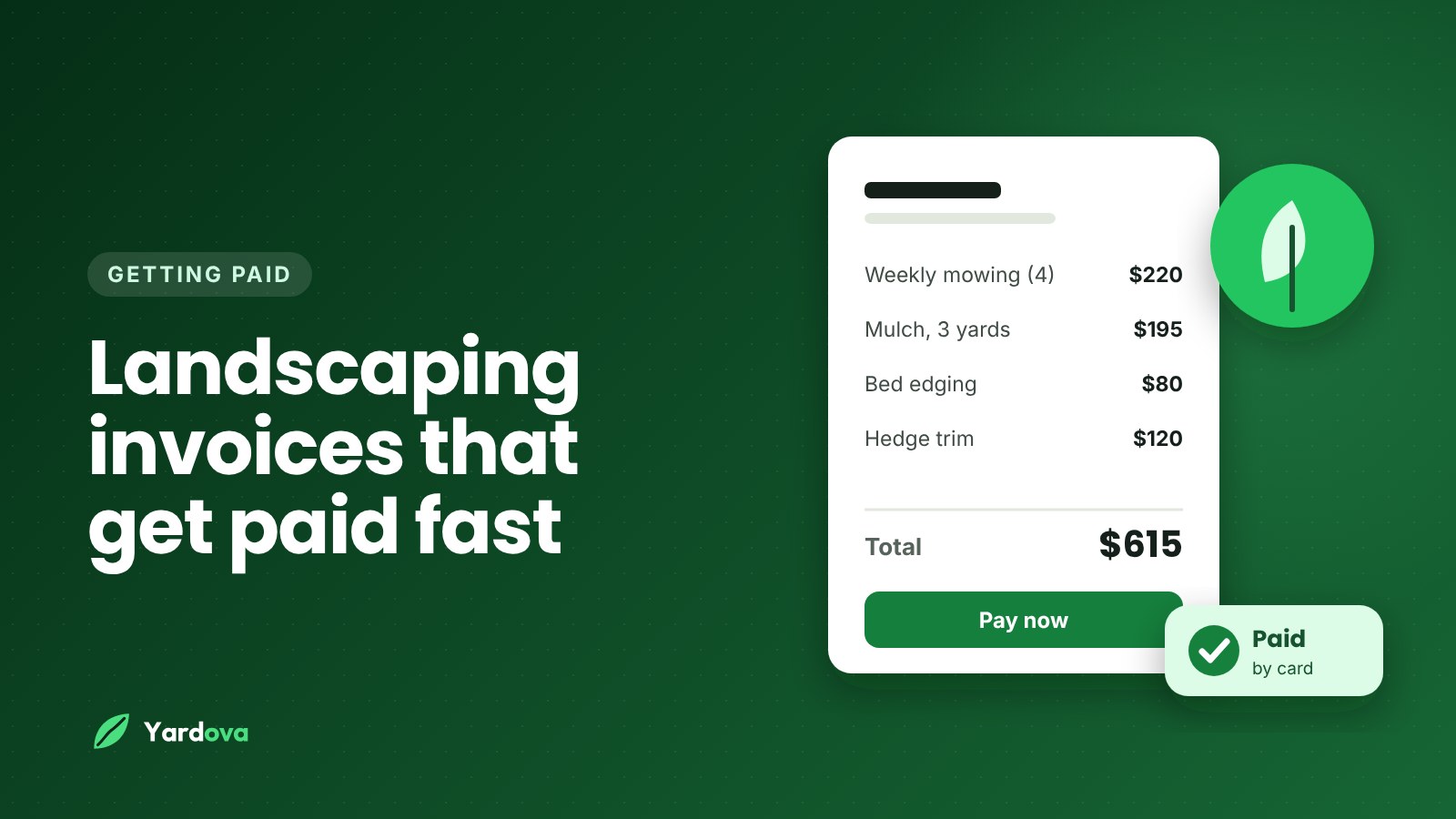
A landscaping invoice is the last thing your customer sees from a job, and it decides how fast the money for that job lands in your bank account. You can lay perfect sod, edge every bed clean and haul off every branch, but if the invoice is vague, late or hard to pay, you end up waiting weeks for money you already earned.
This guide covers what to include, a full example, billing different kinds of work, payment terms, pay links, autopay, reminders and the mistakes that slow payment down. Any dollar amounts below are simple examples to show the layout, not market prices.
Why your landscaping invoice matters more than you think
Many landscaping businesses have a collecting problem more than a pricing problem. The invoice goes out late or not at all, and the owner spends Sunday night trying to remember who still owes for the spring cleanup.
A clear invoice fixes a lot of that. It tells the customer exactly what they're paying for, gives them an easy way to pay right now, and creates a record you can point to later. It also makes a small crew look like an established company.
Landscaping has more billing variety than most trades: weekly mowing, one-time cleanups and two-week patio installs. Each needs a slightly different approach, but the same basic structure works for all of them.
What to include on a landscaping invoice
Think of every invoice as answering three questions: who did the work, what was done, and how does the customer pay. If any of those is fuzzy, payment slows down.
Your business information
- Business name and logo
- Phone number, email and website
- License number if your area requires it on paperwork (requirements vary, so check locally)
Customer information
- Customer name
- Service address
- Billing address if different, such as a property manager
- Phone and email
- PO number, unit number or account number for commercial customers
Invoice number and dates
Every invoice needs a unique, sequential number that is never reused. It makes payments, questions and tax-time records easy to match. Include three dates:
- Invoice date: the day you send it
- Service date or dates: when the work happened
- Due date: when payment is expected
Line items for labor
Labor is usually the biggest part of a landscaping bill. Describe it in plain words the customer recognizes:
- "Weekly mowing, trimming, edging and blowing" instead of "Maintenance"
- "Spring cleanup: bed weeding, leaf removal, cut back perennials" instead of "Cleanup"
- "Install of 3 shrubs and 2 trees, including planting and staking" instead of "Labor"
If you bill hourly, show hours, crew size and rate. Either way, the invoice should match how you quoted the work. If you're still working out your rates, our guide on how much to charge for lawn mowing walks through the numbers.
Line items for materials
Materials are where customers most often ask questions, so list them with quantity and unit:
- Mulch, by the cubic yard or by the bag
- Plants, by size and count, such as "Boxwood, 3 gallon x 6"
- Topsoil, compost or fill, by the yard
- Stone, gravel, pavers and edging, by the ton, yard or square foot
- Sod or seed, by the square foot or pallet
Whether you mark up materials is your call. What matters is a quantity the customer can picture. "Hardwood mulch, 6 yards" is easy to accept. "Materials: $480" invites a phone call.
Equipment and disposal
Some jobs need extra equipment or create debris that costs you money to get rid of. Put these on their own lines:
- Equipment rental, such as a skid steer, sod cutter, aerator or stump grinder
- Delivery fees for bulk materials
- Debris haul-off and dump fees for brush, sod, soil or old stone
Listing these separately shows the customer why a job cost what it did. If you add services like driveway and patio cleaning, our guide on how much to charge for pressure washing shows how to price them.
Sales tax
Sales tax on landscaping is not the same everywhere. Some places tax certain services, some tax materials but not labor, and requirements vary by state, county and city, so ask your accountant or your state tax agency how it works for you. Whatever applies, show tax as its own line rather than hiding it in the total.
Payment terms and payment options
Close the invoice with the rules and the easy button:
- Payment terms, such as "Due on receipt" or "Due within 15 days"
- Any late fee policy, stated plainly
- Accepted payment methods and a link to pay online
- A short thank-you
Landscaping invoice example
Here is a full landscaping invoice example for a spring bed refresh with a small planting. The numbers are made up to show the structure. You can use this layout as a simple landscaping invoice template.
Green Ridge Landscaping Phone: 555-201-4400 - Email and website: [your business email and website] Invoice #2318 Invoice date: April 18 - Service date: April 17 - Due date: April 25 Bill to: Karen M., 88 Birch Lane - Spring cleanup: weed beds, remove leaves, cut back perennials, edge beds (2 crew, 3 hours): $270.00 - Hardwood mulch, 5 cubic yards, delivered and spread: $375.00 - Boxwood, 3 gallon x 4, planted: $180.00 - Hydrangea, 5 gallon x 2, planted: $130.00 - Garden soil, 1 cubic yard: $55.00 - Debris haul-off and disposal: $60.00 - Subtotal: $1,070.00 - Sales tax (only where it applies in your area): shown on its own line - Deposit paid at approval: -$250.00 - Balance due: $820.00 Payment terms: due within 7 days. Pay by card, Apple Pay or Google Pay with the link below. Checks payable to Green Ridge Landscaping. Notes: New plants watered in. Water deeply twice a week for the first month. Thank you for your business.
Every line has a description, a quantity and a price. The deposit shows as a credit, so nobody thinks they're being charged twice. The care note cuts down on "my new shrubs died" calls.
How to invoice for landscaping work of different types
The basic structure stays the same, but how often you bill and what goes on each invoice depends on the kind of work.
Lawn care invoice for weekly maintenance
Weekly mowing is the simplest work to bill and the easiest to let slide. Three common approaches:
- Per visit: accurate, but a lot of small invoices
- Monthly: one invoice listing each visit date
- Autopay after each visit: the saved card is charged when the job is done, so there's nothing to chase
A lawn care invoice for a month might read: "Weekly mowing, trim, edge and blow: May 2, May 9, May 16, May 23, May 30 (5 visits x $45): $225." If a visit was skipped for rain, leave it off. Customers notice, and that honesty builds trust.
One-time cleanups
Spring, fall and storm cleanups are usually one-off jobs. Invoice them on site or the same day. A customer who just watched your crew clear three seasons of leaves is ready to pay. Two weeks later, they've forgotten how bad the yard looked.
List the main tasks, hours if you bill that way, and disposal charges. If the job grew, confirm the change with the customer before you send the bill.
Installs and hardscape projects: deposits and progress billing
Patios, retaining walls, planting plans and sod installs need a different approach. You're buying materials and committing crew days up front, so billing only at the end puts all the risk on you.
Deposits. Ask for a deposit when the customer approves the quote. For projects with heavy material costs, a deposit of around 25 to 50 percent is common practice. Put the amount and your cancellation policy in writing in the quote, and always show the deposit as a credit on the final invoice.
Progress billing. For multi-week projects, split the job into stages and bill as each one is done. A patio install might look like this:
- Deposit at approval
- Second payment when excavation and base are complete
- Third payment when pavers are laid
- Final payment at completion and walkthrough
Spell out the stages in the quote so each invoice is expected. Each progress invoice should show the stage, its amount, payments received and the remaining balance. For more on setting this up from the start, see how to write a quote for a service business.
Change orders. When a customer adds something mid-project, get approval before doing the work. Then list it on the next landscaping invoice as its own line labeled as a change, so it doesn't look like the price crept up.
Seasonal contracts and monthly plans
Many landscapers sell a season package of mowing, cleanups, mulch and pruning at one price. Splitting it into equal monthly payments is easier on homeowners and smooths your cash flow.
For example, a package priced at $2,400 for an eight-month season could be billed as $300 a month. Each monthly invoice should name the plan, the month it covers and what's included, so the customer remembers what they're paying for even in a month with light work.
Spell out in the contract what happens if the customer cancels midseason, since payments may not match work done so far.
Snow removal
Match the snow invoice to how you sold the work:
- Per push or per visit: list each date and time of service and the amount per visit
- Per inch or by snowfall range: show the date and the snowfall tier that applied
- Seasonal flat rate: bill in monthly installments regardless of snowfall
- Salt or ice melt: list applications separately with the date and quantity
Commercial snow customers often want service dates and times for their records, so log every visit.
Landscaping payment terms and late fees
Payment terms say when to pay. A late fee policy says what happens if they don't. Both belong on the quote and the invoice.
Choosing payment terms
- Due on receipt: common for residential maintenance and cleanups
- Due in 7 or 15 days: reasonable for larger residential jobs
- Net 30: common for property managers, HOAs and commercial accounts that pay on a schedule
For homeowners, shorter is better. For commercial accounts, ask about their payment cycle before the first job.
Late fees
A late fee can encourage on-time payment, but keep it reasonable and in writing before work starts. Rules on late fees and interest vary by state, so check what's allowed or ask an accountant or attorney.
- State the late fee on the quote, the agreement and every invoice
- Apply it consistently, or not at all
- For recurring customers, pausing service is often more effective than any fee
How to send a landscaping invoice: text, email and pay links
How you send it matters as much as what's on it. Paper left in a door or mailed days later is the slowest way to get paid.
Send by text and email
Most customers read texts within minutes, so a text with an invoice link beats an envelope. Send by email too for customers and businesses that keep records that way. Send the same day, ideally before the crew leaves. Before texting customers, make sure you have their permission and follow current business texting rules. Asking "Is it OK to text you about your service and invoices?" when they sign up covers most homeowners.
Include a pay link
The biggest single improvement most landscapers can make is a pay link on every invoice. The customer taps it and pays by card, Apple Pay or Google Pay in under a minute. No check, no stamp, no "I'll get to it this weekend."
Card processing costs a few percent, which most owners build into their pricing. Rules on adding card surcharges vary by state and card network, so check before adding one.
If you take payment apps, list them on the invoice and send those payments to a business account.
Autopay for recurring customers
For weekly maintenance and monthly plans, autopay ends the chase. With the customer's clear permission, save their card and charge it after each visit or on a set day each month. Offer it at signup, when it's an easy yes, and let customers update or remove the card easily.
Tipping on invoices
Some customers like to tip a crew after a big cleanup or install. Optional tip choices on online payments make that easy. Never pressure anyone, and decide in advance how tips are split.
Receipts
Send a receipt for every payment, whether card, check, cash or app. It closes the job, gives the customer a record and prevents "did you get my check?" calls.
Chasing overdue invoices: reminder schedule and sample messages
Some invoices will still go past due. Most late payers simply forgot. A steady, polite reminder schedule collects most of them without awkwardness.
A simple reminder schedule
- Day of service: invoice sent by text and email with a pay link
- Due date: friendly reminder if unpaid
- 3 days past due: second reminder
- 7 to 10 days past due: phone call from the owner or office
- 30 days past due: firm written notice explaining next steps, and a pause on recurring service
Sample reminder messages
First reminder, sent on the due date:
Hi Karen, this is Luis with Green Ridge Landscaping. Thanks again for having us do your spring cleanup and planting on April 17. Just a friendly reminder that invoice #2318 for $820 is due today. You can pay by card, Apple Pay or Google Pay here: [pay link]. Reply here with any questions.
Second reminder, a few days past due:
Hi Karen, following up on invoice #2318 for $820 from your April 17 spring cleanup. It's now a few days past due. Here's the link again to pay in a minute or two: [pay link]. If something on the invoice doesn't look right, let me know and I'll sort it out.
Each names the job, invoice number and amount, with a one-tap way to pay. Send reminders during normal hours and keep collections with the owner or office, not the crew.
If late payment is a problem across your whole business, our guide on how to get paid faster as a service business covers more ways to close the gap.
How to invoice for landscaping, step by step
Here's a repeatable process your crew leads can follow on every job. The goal is to have the landscaping invoice out the door before the trailer leaves the curb.
- Start from the approved quote. Pull up the quote the customer agreed to so the invoice matches what was promised.
- Note any changes during the job. Extra mulch, an added shrub or extra debris should be written down as you go, and confirmed with the customer when possible.
- Count materials used. Record mulch, soil, plants and stone before you leave.
- Take before and after photos. They protect you if the work is questioned.
- Build the invoice on your phone. Use saved line items for common services and materials so you're tapping, not typing.
- Apply deposits and progress payments. Show what's already been paid as credits and the balance clearly.
- Check tax and terms. Make sure tax is handled correctly for your area and the due date is set.
- Send by text and email with a pay link. If the customer is home, walk them through it and let them pay on the spot.
- Send a receipt when paid. Close the loop the same day.
- Set reminders for anything unpaid. Don't rely on memory to follow up.
With practice, this takes about five minutes per job.
Common landscaping invoice mistakes
These are the mistakes that most often slow down payment or cost landscapers money:
- Invoicing days or weeks late. Every day an invoice waits, the work feels less valuable to the customer.
- Vague line items. "Landscaping services: $1,200" invites questions. Itemized invoices get paid.
- Forgetting materials. The crew spreads 2 extra yards of mulch and nobody bills for it.
- Skipping disposal charges. Dump fees and haul-off add up quickly when you eat them.
- No deposit on big installs. You end up fronting thousands in pavers and plants with no protection.
- Surprise charges. A fee that wasn't in the quote damages trust, even when it's fair.
- Not showing the deposit as a credit. Customers think they're being double-charged and call you about it.
- No easy way to pay. If the only option is mailing a check, expect to wait.
- No follow-up system. Unpaid invoices don't collect themselves.
Most of these happen when invoicing is done from memory at the end of a long day.
Landscaping invoice checklist
Run through this list before anything goes out:
- Business name, logo and contact info are correct
- Customer name, service address and billing address are correct
- Invoice number is new and in sequence
- Invoice date, service dates and due date are filled in
- Labor is described in plain words with hours or a flat price
- Materials list quantities and units
- Equipment rental, delivery and disposal are on their own lines
- Deposits and progress payments are shown as credits
- Sales tax is handled correctly for your area and shown separately
- Payment terms and any late fee policy are stated
- Payment methods are listed and a pay link is included
- PO or account number is included for commercial customers
- Before and after photos are saved to the job
Landscaping invoice template vs. invoicing software
A paper invoice book or spreadsheet template is fine for a handful of customers. It breaks down when you're billing dozens of properties a week. Paper gets lost, can't take cards and never sends a reminder. A spreadsheet template helps with layout, but you still send it and track payment somewhere else.
What to look for in landscaping invoicing tools
- Invoices you can build and send from your phone on site
- Saved line items for services and materials
- Card, Apple Pay and Google Pay, with money going to your own bank account
- Pay links sent by text and email
- Deposits collected when a quote is approved
- Saved cards and autopay for recurring customers
- Automatic payment reminders
- A simple view of who owes you money
Yardova's lawn care and landscaping software handles this workflow. Invoices go out by text or email with your logo and colors, and customers pay by card, Apple Pay or Google Pay through your own Stripe account, so the money goes straight to your bank. You can collect a deposit when a quote is approved, set up autopay after each visit or on monthly plans, offer optional tips, text receipts and let automatic reminders follow up on overdue invoices.
Frequently asked questions
What should be included on a landscaping invoice?
A landscaping invoice should include your business info, the customer's info, a unique invoice number, the invoice date, service dates and due date. List labor, materials with quantities, equipment and disposal on separate lines, plus sales tax where it applies. Finish with deposit credits, the balance due, payment terms and how to pay.
How do I invoice for landscaping work?
Invoice for landscaping by starting from the approved quote, recording changes and materials used, and building an itemized invoice the same day. Send it by text and email with a pay link, and follow up on a set schedule if it goes unpaid.
How much deposit should a landscaper ask for?
Many landscapers skip deposits on routine maintenance and take them on installs and hardscape projects. For projects with significant material costs, a deposit of around 25 to 50 percent of the estimate is common practice. Put the amount and your cancellation policy in writing and show the deposit as a credit on the final invoice.
Should I invoice lawn care customers weekly or monthly?
Either works. Monthly invoices that list each visit date mean fewer invoices to track. Autopay after each visit is often easiest because there's nothing to chase.
Do landscapers charge sales tax?
It depends on where you work and what you sell, since rules vary by state, county and city. Check with your state tax agency or an accountant, and show any tax as a separate line on the invoice.
What do I do if a customer won't pay a landscaping invoice?
Start with polite reminders by text and email, then a phone call about a week past due. If it's still unpaid around 30 days, send a firm written notice and pause any recurring service. For larger unpaid amounts, ask an attorney about your options, since collection rules vary by state.
Wrap-up: send a landscaping invoice that gets paid fast
A strong landscaping invoice comes down to a few habits:
- Itemize labor, materials, equipment and disposal in plain words
- Match the invoice to the quote and confirm changes before you bill them
- Take deposits on installs and bill big projects in stages
- Send invoices the same day by text and email with a pay link
- Use autopay for weekly and monthly customers
- Follow up on a steady reminder schedule
Do this on every job and you'll spend less time chasing money. To see how this works in practice, start a free Yardova account, compare plans and pricing, or book a demo and we'll walk you through invoicing from your phone.