How to Start a Junk Removal Business: A One-Truck Guide
How to start a junk removal business with one truck: example startup budgets, setup, disposal, pricing, first customers and a 30-day launch plan.
The Yardova team · November 2, 2026 · 16 min read
If you're figuring out how to start a junk removal business, the good news is that the barrier to entry is low: a truck or trailer, a strong back, a phone and a way to get paid. The hard part is everything around the hauling, such as pricing loads so you actually make money, knowing where the junk goes, and answering leads fast enough to win them.
This guide walks through it step by step for someone launching with one truck. It covers choosing a truck or trailer, example startup budgets, basic business setup, disposal, pricing, your first customers, getting paid on site, your first helper, the tools you'll need, and when to add a second truck. Any dollar amounts below are simple examples to show the math, not industry statistics.
How to start a junk removal business: the short version
Here's the whole path in order. Most one-truck operators can work through it in a few weeks.
- Choose your hauling setup: a dump trailer, box truck or dump truck.
- Build a startup budget and know how many jobs it takes to cover it.
- Set up the business: registration, local licensing and insurance.
- Map your disposal options: transfer stations, landfills, donation and recycling.
- Set volume-based prices with clear surcharges.
- Get found with a Google Business Profile, a quote request page and a business phone number.
- Answer every lead fast and send a clear price.
- Get paid on the spot from the driveway.
- Ask for reviews after every good job.
- Add help and grow once the first truck is consistently full.
If you only remember one thing about how to start a junk removal business, make it this: the companies that win are the ones that answer first and price clearly.
Junk removal truck vs trailer: choosing your first setup
Your hauling setup is the biggest early decision, because it drives your startup costs, the size of jobs you can take and how many dump runs you make each day.
Pickup and dump trailer
Many owners start with a pickup they already own and a dump trailer. The trailer's hydraulic bed means you can empty a load in minutes instead of hand-unloading it at the transfer station.
- Pros: Lower upfront cost if you own a capable truck, and the trailer can be dropped at a site for multi-day cleanouts.
- Cons: Tight driveways take practice, and your truck must be rated to tow the trailer fully loaded.
- Best for: Owners keeping costs low.
Box truck with a junk body
A box truck (or a truck with a purpose-built junk body) gives you a big, enclosed space with high walls.
- Pros: Large volume per trip, looks professional and keeps light junk from blowing out.
- Cons: Hand-unloading takes longer unless the body dumps, and it's a bigger purchase.
- Best for: Furniture, household cleanouts and bulky but light items.
Dump truck
A dump truck unloads fast and handles heavy material like concrete, dirt and roofing debris, but it costs more to buy and maintain and may hold less bulky household junk than a box truck.
How to decide
If your area is full of homeowners clearing garages and basements, volume matters most. If you expect contractor debris, weight and dumping speed matter more. Either way, check weight ratings and towing capacity, and ask your insurance agent about coverage for a business vehicle.
Junk removal startup costs: example budgets
What it costs to start a junk removal business depends mostly on whether you already own a truck. Below are two example budgets. Your local prices will differ, so treat them as a template, not a quote.
Example budget 1: lean start with a truck you already own
- Used dump trailer: $6,000
- Business registration and local permits: $300 (varies widely by location)
- Insurance down payment: $800
- Basic tools (dollies, straps, tarps, gloves, shovels, brooms): $600
- Truck and trailer signage or magnets: $300
- Simple website and business cards: $200
- Software and business phone: $0 to $50 a month
- Starting cash for dump fees and fuel: $1,000
Example total: about $9,200 to get rolling.
Example budget 2: buying a used box truck
- Used box truck: $25,000
- Registration, permits and insurance down payment: $1,800
- Tools and safety gear: $800
- Vehicle wrap, website and printed materials: $3,400
- Starting cash for dump fees, fuel and repairs: $2,000
Example total: about $33,000, much of which could be financed.
Monthly costs and break-even example
Your ongoing costs decide whether you're profitable: truck payment, insurance, fuel, dump fees, maintenance, helper wages, and phone, software and marketing.
Say your fixed monthly costs (truck payment, insurance, phone, software, marketing) come to $2,000 in this example, and an average job leaves you $150 after dump fees, fuel and helper pay. You'd need about 14 jobs a month just to break even. Running this math early is one of the most useful junk removal business plan exercises you can do, because it tells you how many jobs you need each week before you pay yourself.
Business setup: registration, licenses and insurance
This part of how to start a junk removal business is boring but important. Requirements vary by state, county and city, so the steps below are general. Check with your local licensing office, an insurance agent and an accountant before you take paid jobs.
Register the business
- Choose a business name and check that it isn't already taken in your state.
- Decide on a business structure. Many small operators form an LLC, but an accountant can tell you what fits your situation.
- Get a tax ID if your structure or hiring plans require one.
- Open a separate business bank account so job income and expenses don't mix with personal money.
Junk removal business license and permits
Some cities and counties require a general business license. Some areas also have rules for waste haulers, vehicle weight, commercial vehicle registration or where you can dispose of certain materials. Call or visit your local licensing office and ask specifically about hauling and waste transport so you're not guessing.
Insurance
Insurance protects you when a couch scrapes a door frame or a box falls on someone's car. Common types of coverage hauling companies look at include general liability, commercial auto and, once you hire, workers' compensation. What's required and what makes sense depends on your state and the work you do. An insurance agent who works with contractors or haulers can explain your options. And from day one, keep every receipt, dump ticket and fuel slip, and ask an accountant about estimated taxes.
Disposal: transfer stations, landfill fees, donation and recycling
New operators often underestimate disposal. What happens to the junk after it's in your truck is a big part of your costs, your schedule and your reputation.
Transfer stations and landfills
A transfer station is a facility where you drop off waste that's later moved to a landfill or processing site. Landfills accept waste directly. Both usually charge by weight or by load, and many have separate fees for items like mattresses, tires, appliances or electronics.
Before your first job, do this:
- List every transfer station and landfill within a reasonable drive.
- Write down hours, accepted materials, refused items and fees.
- Ask whether they offer commercial accounts for haulers.
- Keep that list in your phone for quoting and planning.
Hours matter. If the nearest transfer station closes at 3:30, a late job may mean driving home loaded.
Donation and recycling
A lot of junk isn't junk. Usable furniture and working appliances can often go to donation centers or reuse groups, metal to scrap yards, and electronics and cardboard to local recyclers. Call ahead to ask what each accepts. Diverting items lowers your dump fees and gives you a good story for customers who care where their stuff goes.
Items that need special handling
Paint, chemicals, tires, batteries and refrigerant appliances often have special disposal rules that vary by location. Check with your local waste authority and decide up front what you'll take, what carries a surcharge and what you'll turn down.
Junk removal pricing by volume
Pricing is the step of how to start a junk removal business where new haulers most often lose money. The most common approach is pricing by how much of the truck a load fills, with surcharges for things that cost you extra.
A simple volume-based price list
Here's a typical structure (set your own dollar amounts based on your costs and local market):
- Minimum charge or single item
- Quarter truck
- Half truck
- Three-quarter truck
- Full truck
- Surcharges for stairs, long carries, heavy material and special items like mattresses or tires
For a full walkthrough with examples, read our guide on how to price junk removal.
Pricing tips for new haulers
- Know your cost per load first: dump fees, fuel, labor and truck wear.
- Don't price to be the cheapest. Customers care more about a fast reply, a clear price and showing up on time.
- Quote from photos, confirm on site with a range or an "up to" price.
- Charge for heavy material. A quarter truck of concrete weighs far more than a quarter truck of cushions.
Example: checking one job
For example, a half-truck job billed at $350 with a $60 share of the dump fee, $50 in helper pay and $25 in fuel and wear leaves $215 before overhead. If the same job had been up two flights of stairs with no surcharge, it might have taken twice as long. That's why surcharges belong on your price list from day one.
How to get junk removal customers (and answer every lead)
Once the truck is ready, the next part of how to start a junk removal business is getting the phone to ring. You don't need a big marketing budget at first. You need to be easy to find, easy to contact and quick to answer.
Set up your Google Business Profile
For local services, your Google Business Profile is often the first thing a customer sees. Set it up before you spend a dollar on ads: pick an accurate category, set your real service area, add photos of your truck and before-and-after jobs, and list a phone number you'll actually answer.
Build a quote request page
A simple page where customers describe the job and upload photos lets you quote most jobs without a site visit. Ask for contact details, what needs to go, where the items are (curb, garage, basement, upstairs), photos and a preferred date. Link it from your Google profile and website.
Get your first reviews
Reviews build trust fast when you're new. Ask every happy customer, right after the job, while they're standing in a clean garage. Google has rules about reviews, such as not offering incentives in exchange, so check the current guidelines. Our post on how to get more Google reviews lays out a simple system.
Realtors, property managers and repeat work
Some of the best early customers aren't homeowners. Realtors need houses cleared before listing. Property managers need units emptied after move-outs. Contractors need debris hauled.
Drop off a card and short price sheet at real estate offices, and email property managers offering quick move-out cleanouts with photos and easy invoicing. Here's a short message you can adapt:
Hi Maria, I run a local junk removal company here in town. I help property managers clear out units after move-outs, usually within a day or two of the call. I send before and after photos and can invoice the owner or the management company directly. If you ever need a unit cleared, I'd be glad to help. Here's my number and a link to request a quote.
Answer calls and reply to leads fast
Junk removal customers are often in a hurry, and many contact two or three companies and book whoever replies first with a clear price. You're often on a job with gloves on, so a few habits help:
- Use a dedicated business number so work calls don't mix with personal ones.
- Set up a missed-call text back so every caller gets a reply.
- Reply to web leads within minutes, even just to ask for photos.
- Check voicemail between jobs, not at the end of the day.
A simple instant reply might read:
Hi, thanks for contacting Hill Country Hauling. We're on a job right now but want to get you a price fast. Can you text a few photos of the items and let us know where they are (garage, basement, upstairs)? We'll send a quote shortly.
For more on why this matters, see how missed calls cost service businesses jobs.
Invoicing and getting paid on the spot
The best time to get paid for a junk job is the moment the truck is loaded and the customer is looking at an empty garage. Waiting a week to send a bill just gives you something else to chase.
How to collect on site
- Confirm the final load size before you start loading.
- Adjust the invoice if the volume or surcharges changed.
- Send the invoice by text or email from your phone.
- Let the customer pay by card, Apple Pay or Google Pay, then send a receipt.
- Take after photos and mark the job complete.
Deposits and commercial billing
For large estate cleanouts or jobs booked weeks out, a deposit protects your day if the customer cancels. A deposit of around 25 percent is common for bigger jobs, while many haulers skip deposits on small same-day pickups. Property managers and contractors may want to pay on terms, so set clear due dates and send reminders.
Our guide to junk hauling invoicing covers invoice layouts, payment methods and on-site collection in more detail.
Tools and software for a new junk removal company
You don't need much to start, but you do need the right basics.
Physical tools
- Furniture dollies and an appliance hand truck
- Ratchet straps, tarps and contractor bags
- Shovels, rakes and push brooms
- Gloves, safety glasses, steel-toe boots and dust masks
- A basic tool kit and a first aid kit
The software stack
Part of how to start a junk removal business without chaos is deciding early where leads, jobs and payments live. Personal texts, a notes app and a paper calendar work for the first handful of jobs. After that, leads get lost and nobody remembers who still owes money.
A simple software stack for a new hauling company covers:
- A business phone number with texting and a missed-call text back
- A quote request page that accepts customer photos
- A saved price list with your volume tiers
- Scheduling with reminders and "on my way" texts
- Invoicing and card payments from your phone
- Automatic review requests and a shared customer list
If you'd like a detailed comparison of what to look for, read our buyer's guide to junk removal business software. For a broader view of keeping customers organized, see CRM for small service businesses.
Launch checklist: how to start a junk removal business the right way
Use this junk removal business checklist before you take your first paid job, then follow the 30-day plan below.
Pre-launch checklist
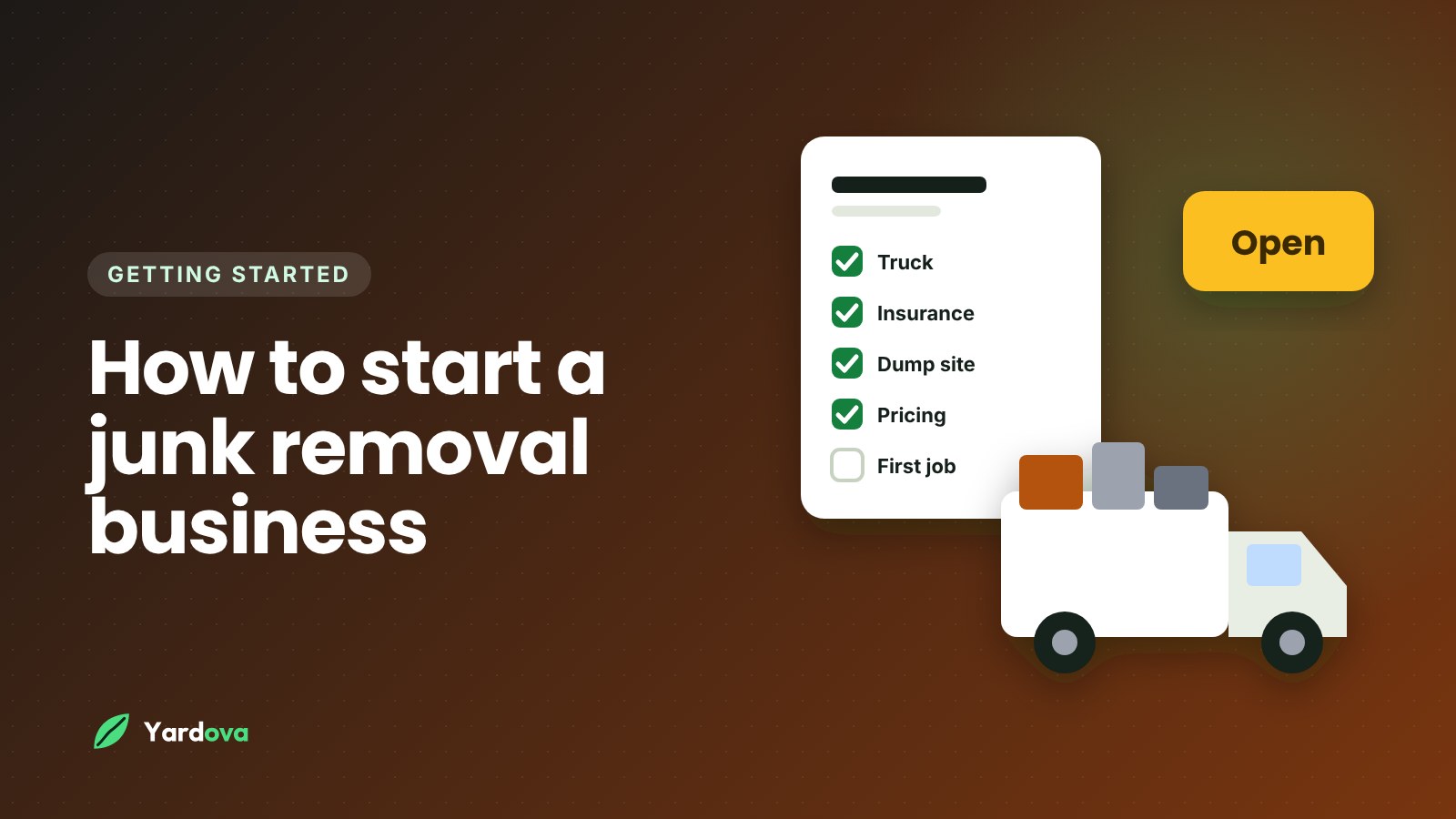
- Truck or trailer purchased, inspected and rated for the loads you'll carry
- Business registered and separate bank account opened
- Local licensing and permit requirements checked with your licensing office
- Insurance in place after talking with an agent
- Disposal list built: transfer stations, landfills, donation centers, scrap and recycling
- Volume-based price list with surcharges written down
- Google Business Profile created and verified
- Quote request page live with photo uploads
- Business phone number with missed-call text back set up
- Card payments working on your phone
- Tools, straps, tarps and safety gear in the truck
- Message templates written: instant reply, quote, booking confirmation, review request
Your first 30 days: a step-by-step plan
- Days 1-3: Finish your price list and test each tier against your costs on a few imaginary jobs.
- Days 1-3: Set up your Google Business Profile, quote request page and business phone number.
- Days 4-5: Call each transfer station and donation center to confirm hours, fees and accepted items.
- Days 4-5: Run a test lead from quote request to paid invoice, using a small charge on your own card.
- Days 6-7: Tell everyone you know you're open and post in local community groups.
- Week 2: Contact at least ten realtors and property managers.
- Week 2: Do your first jobs, take before and after photos and ask for reviews.
- Week 3: Add your best photos to your Google profile and reply to every review.
- Week 3: Review jobs done, average job size, dump fees and time per job. Adjust tiers if needed.
- Week 4: Follow up on every unanswered quote and referral contact.
- Day 30: Decide whether you need a regular helper and set next month's goals.
Hiring your first helper and growing to a second truck
Most junk removal jobs need two people, since couches, appliances and mattresses are hard to move safely alone.
Hiring your first helper
- Start with part-time or on-call help before committing to full-time hours.
- Hire for reliability over experience. Showing up on time and respecting customers' homes matter most.
- Train on safe lifting and etiquette, like protecting door frames and asking before moving anything.
- Track hours with a simple time clock.
- Check employment rules. Employee versus contractor, insurance and taxes vary by state, so ask an accountant first.
For tips on running a crew day, read our guide on crew scheduling for service businesses.
Signs you're ready for a second truck
How to grow a junk removal business usually comes down to one question: is the first truck turning away work? Watch for these signs:
- You're consistently booked days out and losing same-day jobs.
- You have a helper who could reliably lead a crew.
- Your numbers show steady profit after paying yourself, not just busy weeks.
Some haulers add a second service instead of a second truck, such as pressure washing for the same homeowners and property managers. If that's your plan, read how much to charge for pressure washing before you quote your first job.
How to add the second truck without chaos
- Run the numbers with a second truck payment, insurance and crew wages included.
- Promote your most reliable helper to crew lead and hire a new helper.
- Put every job, customer and payment in one shared system, color-coded by truck.
- Set clear rules for photos, checklists and collecting payment so both crews work the same way.
Frequently asked questions
How much does it cost to start a junk removal business?
The cost to start a junk removal business depends mostly on whether you already own a capable truck. As an example, a lean start with an owned pickup and a used dump trailer might run under $10,000, while buying a used box truck might push the total above $30,000. Build your own budget using local prices for vehicles, insurance and disposal.
Is a junk removal business profitable?
A junk removal business can be profitable if your prices clearly cover dump fees, fuel, labor and truck costs with room left over. The owners who struggle usually underprice heavy loads, skip surcharges or don't track disposal costs. Check your numbers on a sample of jobs each month and adjust your tiers.
Do I need a license to start a junk removal business?
Whether you need a license depends on your state, county and city. Some areas require a general business license, and some have extra rules for waste haulers or commercial vehicles. Contact your local licensing office and ask specifically about hauling and waste transport.
Should I start a junk removal business with a truck or a trailer?
A pickup with a dump trailer is the lower-cost way to start a junk removal business if you already own a truck that can tow it. A box truck holds more bulky household junk and looks professional, but costs more upfront. Choose based on the jobs most common in your area.
How do I get my first junk removal customers?
Get your first junk removal customers by setting up a Google Business Profile, a quote request page and a business phone number you answer fast. Then tell friends and family, post in local groups and reach out to realtors and property managers. Ask every happy customer for a review to build trust quickly.
How should I price junk removal jobs?
Most haulers price junk removal by volume, with tiers like quarter, half, three-quarter and full truck. Add surcharges for heavy material, stairs, long carries and special items such as mattresses or tires. Quote from photos and confirm the final volume on site before loading.
Wrap-up: how to start a junk removal business that lasts
Learning how to start a junk removal business is mostly about getting the basics right before the first job: the right hauling setup, a real budget, registration and insurance, and a plan for every load. From there:
- Price by volume with surcharges that cover your real costs
- Be easy to find and quick to reply, especially to missed calls
- Get paid on site, before the truck leaves the driveway
- Ask every happy customer for a review
- Add a helper, then a second truck, only when the numbers say so
When you're ready to get organized, Yardova brings your leads, quotes, scheduling, invoices and review requests together in one app built for small crews. See how it works for hauling on our junk removal software page, compare plans and pricing, or start a free Yardova account with no card needed and run your first jobs through it.