Lawn Mowing Price Per Acre: How to Bid Big Properties
Set your lawn mowing price per acre: measure acreage, time your mower's production rate, adjust for slopes and obstacles, and bid HOA and commercial sites.
The Yardova team · November 4, 2026 · 16 min read
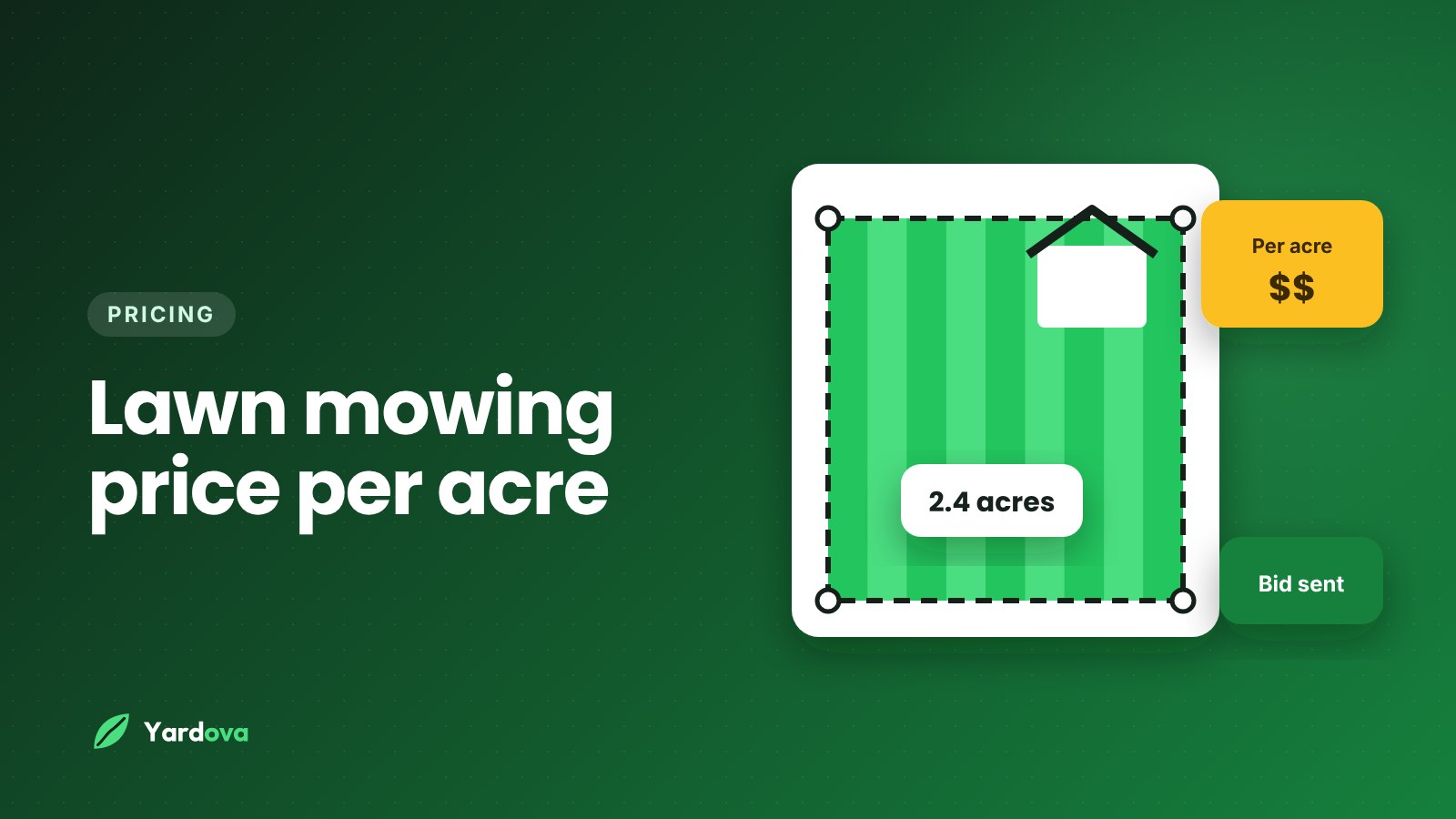
Your lawn mowing price per acre decides whether big properties are the best stops on your route or the ones that quietly eat your week. A two-acre lot, a church campus or an HOA common area can fill a full morning, so a small mistake in the per-acre math gets multiplied every visit, all season long.
This guide is for owners who already mow residential yards and want to take on larger lots, acreage properties, HOAs and commercial sites. If you are still working out your basic hourly rate, minimums and first-cut fees, start with our guide on how much to charge for lawn mowing. This post picks up where that one stops: measuring acreage, timing your machines, costing a machine hour and building bids for bigger ground.
Every figure below is an example to show the method. Prices for acreage mowing vary widely by region, season, equipment and competition, so use your own costs and timed rates.
Why price mowing by the acre (and when not to)
On big, open ground, time on site tracks closely with area. Once the mower is running long straight passes, every extra acre adds a fairly predictable amount of time. That makes per-acre pricing fast to quote and easy to explain.
Where per-acre pricing works well
- Large residential lots, roughly half an acre and up, with mostly open turf
- Rural homes and acreage properties
- HOA common areas, retention ponds and greenbelts
- Commercial sites like office parks, churches, schools and industrial lots
- Vacant lots and fields that need periodic cutting
Where it breaks down
Per-acre pricing falls apart on small lots. A quarter-acre city yard is mostly fixed time: unloading, trimming around beds, blowing the walk and loading back up. The mowing itself might be ten minutes. Multiply a per-acre rate by 0.25 and you will badly underprice the stop.
It also breaks down on detailed properties of any size. A one-acre estate with dozens of beds, a pool fence and stone walls takes far longer than an open acre. For those, price the open area by the acre and the detail work separately.
A simple rule: use per-acre pricing as the engine for open ground, and keep your minimum charge and time-based pricing for small and detailed sites.
How to measure lawn acreage accurately
Your lawn mowing price per acre is only as good as your acreage number. Quote three acres when the mowable area is two and you lose the bid or overcharge. Quote two when it is really three and you lose money every week.
Start with an online satellite map
Most online map services and many free measuring tools let you trace an outline on a satellite view and get the area. Trace the actual turf, not the property line, and zoom in close enough to follow bed edges and driveways.
- Satellite images can be a year or more old, so new beds, sheds or pools may be missing
- Tree canopy hides the ground, so turf under big trees is easy to miss or overcount
- Measure in square feet, then divide by 43,560 to get acres
Check property records, then walk it
County property records list lot size, which is useful as a ceiling. A two-acre parcel almost never has two acres of mowable grass once you take out the house, driveway, outbuildings, woods and beds.
For any property you plan to bid seriously, walk it. You will find things the map can't show: soft spots, ditches, steep banks, irrigation heads, low branches and areas the owner wants left alone.
Subtract what you won't mow
Your billable acreage is the turf you actually cut. Subtract:
- The house, garage, sheds and other buildings
- Driveways, parking lots, sidewalks and patios
- Landscape beds, tree rings and gardens
- Ponds, wooded areas and fenced-off zones
- Any area the customer wants left natural
For example, a 2.5-acre parcel might measure 1.6 acres of turf after you trace it and subtract everything else. Price the 1.6, not the 2.5.
Mowing production rates by deck size
Production rate is how many acres per hour a machine actually cuts. It is the core of any per-acre price, and it is different for every operator, machine and property.
A rough starting estimate
You can estimate a theoretical rate from deck width and ground speed:
- Convert the deck width to feet (a 60-inch deck is 5 feet)
- Multiply by your mowing speed in miles per hour
- Multiply by 5,280 to get square feet per hour
- Divide by 43,560 to get acres per hour
- Reduce it for turns, overlap and slowing near edges
Example only: a 60-inch deck at 6 mph works out to about 3.6 acres per hour in theory. After turns, overlap and obstacles, the real number might land closer to 2.5 to 3 acres per hour on open ground. This gives you a ballpark. It does not replace timing your own work.
Time your own production rates
The most valuable pricing data you have is your own. For the next few weeks, on every larger property:
- Note the measured turf acreage
- Time mowing from first pass to last
- Time trimming and blowing separately
- Write down the machine, the operator and the conditions (dry, wet, tall, hilly)
After a dozen or so properties, you will have real acres-per-hour numbers for each mower on open, obstructed and hilly ground. Keep them in a simple sheet and update them each season.
Example production rate sheet
Here is what a finished sheet might look like. These are made-up example numbers, not industry rates:
- 21-inch push mower: around 0.2 to 0.3 acres per hour
- 48-inch stand-on: around 1.5 to 2 acres per hour on open turf
- 60-inch zero-turn: around 2.5 to 3 acres per hour on open turf
- Any machine on heavily obstructed ground: often half its open-ground rate or less
An experienced operator on a familiar property can be much faster than a new hire on a first visit. Build bids from your crew's typical rates, not the best day you ever had.
Cost per machine hour: a worked example
Once you know acres per hour, you need to know what an hour of that machine and operator costs. Cost per hour divided by acres per hour gives you cost per acre.
What goes into a machine hour
- Equipment: purchase price minus expected resale, divided by expected hours of use
- Fuel: gallons per hour times your fuel price
- Maintenance and wear: blades, belts, oil, filters, tires and repairs
- Operator labor: wage plus payroll costs, if you have employees
- Overhead share: truck, trailer, insurance and office costs spread across billable hours
- Profit: what the business keeps on top
Worked example
Here is an example for a 60-inch zero-turn with one operator. All numbers are examples to show the math.
- Mower costs $14,000, expected resale $4,000, expected life 2,000 hours: $5 per hour
- Fuel: about 1.5 gallons an hour at $3.50, or about $5.25 per hour
- Maintenance and wear: $4 per hour
- Operator labor with payroll costs: $24 per hour
- Overhead share: $15 per hour
- Total cost: about $53.25 per hour
- Add 20 percent profit: about $64 per machine hour
If this machine averages 2.5 acres per hour on open ground, your mowing cost is about $64 divided by 2.5, or roughly $26 per acre for cutting alone.
That is not your price yet. It covers only time with the mower running. Trimming, blowing, travel and setup still need to be added, which is where many acreage bids go wrong.
Do this for every mower you own. A bigger deck usually has a higher cost per hour but a lower cost per acre on open ground, which tells you which machine to send and what the job really costs.
Adjusting your lawn mowing price per acre for real conditions
Your base lawn mowing price per acre assumes open, flat, dry turf at normal height. Adjust from there.
Obstacles and slopes
Trees, signs, light poles, islands and beds force slow turns and extra passes. One way to handle it is a multiplier on mowing time, for example:
- Open ground: base rate
- Light obstacles (scattered trees, a few beds): add 15 to 25 percent
- Heavy obstacles (dense trees, many islands): add 40 percent or more, or time it separately
Hills slow mowers down and can force a switch to a walk-behind or string trimmer. Steep banks add safety risk and wear. Measure slope areas separately and apply your slower hilly-ground rate to them. Check these example percentages against your own timed jobs.
Wet or tall grass
Wet grass clumps, clogs decks and forces slower speeds. Tall grass after a rain delay can cut your production rate sharply. Put language in your quote that covers overgrowth, such as an extra charge if grass exceeds a set height because of skipped or delayed visits the customer requested.
Trimming and blowing time
On large properties, trimming and blowing can rival mowing time. Fence lines, building edges, curbs and pond edges all need string trimming. Parking lots and walks need blowing.
- Measure trim lines in linear feet and time how many feet per hour your crew trims
- Note hard surfaces that need blowing and time those too
- Add edging if it is part of the service
A commercial lot with 1,800 feet of curb and fence line might need as much trimming time as mowing time, even though the acreage looks simple on a map.
Travel and trailer time
Big properties often sit outside your normal route. Every bid should include drive time, unloading and loading time for each machine, and time to move equipment between separate areas on the same property.
If a five-acre site takes 40 minutes round trip from your nearest stop plus 20 minutes to unload and load, that is an hour of crew time before the first blade turns. Build it into the price or schedule the property alongside nearby stops. Our guide to crew scheduling for service businesses covers grouping big stops into efficient days.
Pricing mixed properties
Most larger properties are a mix: two acres of open lawn plus a detailed front yard, or open fields in back and tight islands near the entrance. Price each zone separately:
- Open acreage: turf acres at your timed rate for that machine
- Detailed areas: priced by time, like a residential yard
- Trim lines: linear feet at your trimming rate
- Blowing: priced by time
- Travel and setup: a flat amount per visit
Example only, using the $64 machine hour from above:
- Open back lawn: 2.2 acres at 2.5 acres per hour is about 53 minutes, or about $56
- Front yard detail with push mower and beds: 35 minutes, or about $37
- Trimming fence line and ditch bank: 30 minutes, or about $32
- Blowing driveway and walks: 10 minutes, or about $11
- Travel, unloading and loading: 25 minutes, or about $27
- Total: about $163 per visit
Breaking it into zones also makes your quote easier to defend when a customer asks why the price is what it is.
Field and brush mowing versus finished turf
Not all acres are lawns. Field mowing, brush hogging and pasture cutting are different services with different equipment, rates and risks.
Finished turf is cut at a set height on a regular schedule, with clean edges and blown surfaces. Customers expect a manicured result, so production rates per machine are lower because quality matters.
Field and brush mowing usually means cutting tall grass, weeds and light brush on vacant lots or pastures, with a tractor and rotary cutter or a heavy-duty brush mower, a few times a season, with a rougher finish. It is often priced per acre per cut at a higher machine-hour rate. Watch for:
- Rocks, stumps, metal, wire and trash hidden in tall grass
- Soft or wet ground that can bury a tractor
- Wildlife, nests and hives
- Steep ditches and pond banks
Always walk a field before bidding it, and price the first cut of an overgrown field separately from maintenance cuts. If you find stumps that need to come out, see how much to charge for stump grinding.
Commercial mowing bids and HOA contract pricing
Commercial and HOA work is where per-acre pricing is most common and where bids get compared side by side. A clear bid matters as much as the number.
Understand the scope before you price
- A site map with mowable areas marked
- Mowing frequency and season length
- Mowing height and whether clippings stay or go
- Trimming, edging and blowing expectations
- Whether leaf cleanup or bed maintenance is included
- Access hours and restrictions (business hours, school pickup times)
- Insurance certificates the property requires
Insurance, licensing and contract requirements vary by state, county, city and property. Check with your insurance agent and local licensing office before committing to a commercial contract.
Per-visit vs monthly vs seasonal contracts
- Per visit: a set price each time you mow. Simple, but income swings with weather and the property may skip visits in dry spells.
- Monthly: the season's total split into equal monthly payments. Smooths cash flow for both sides.
- Seasonal contract: a total price for the full scope over the season, often paid monthly. Gives you a planned route, but you carry the risk of a wet, fast-growing year.
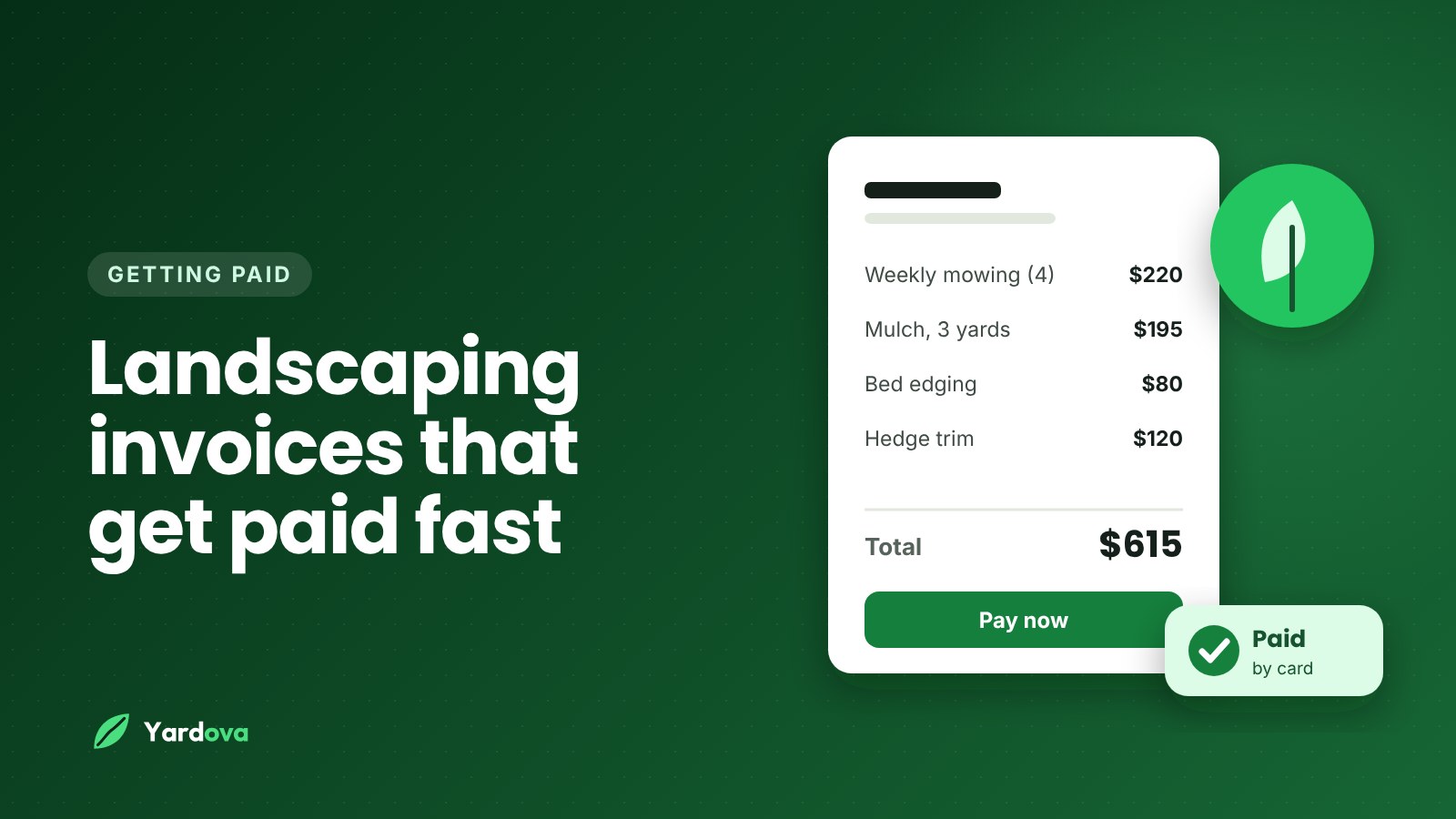
Whichever you choose, list the expected number of visits, what each visit includes and how extra work is priced. For monthly deals, invoices that go out on the same day each month save chasing. Our post on landscaping invoices covers what to include.
HOA mowing contract pricing tips
- Boards change, and new members may rebid every year
- Common areas are often spread out, which adds move time between areas
- Residents will notice and report every missed edge
- Decisions can take weeks while the board meets
Price the move time between common areas, not just total acreage, and keep your bid easy to read for a board that may have never priced mowing before.
Lawn mowing price per acre examples
These are worked examples, not market prices. Acreage mowing cost varies widely by region, so your rates should come from your own costs and timed production.
Example 1: open rural lawn
- 3 acres of open, mostly flat turf
- 60-inch zero-turn at a timed 2.8 acres per hour: about 64 minutes
- Light trimming around the house and trees: 20 minutes
- Travel and setup: 20 minutes
- About 104 minutes at $64 an hour is roughly $111 per visit, or about $37 per acre all-in
Example 2: church property
- 4 acres of turf with scattered trees and two parking lots
- Mowing with a 25 percent obstacle adjustment: about 2 hours
- Trimming curbs and building edges: 50 minutes
- Blowing lots and walks: 30 minutes
- Travel and setup: 15 minutes
- About 3 hours 35 minutes at $64 an hour is roughly $230 per visit
Example 3: overgrown vacant field
- 5 acres of tall grass and weeds, cut three times a season
- Tractor and rotary cutter at an example rate of $85 per machine hour
- Timed rate in tall growth: about 1.5 acres per hour, or about 3 hours 20 minutes
- Travel and trailer time: 40 minutes
- About 4 hours at $85 is roughly $340 per cut
The all-in price per acre differs in every example. That is the point: a single lawn mowing price per acre for every property will overcharge some and undercharge others.
How to bid an acreage property: checklist, steps and sample quote
Per acre pricing checklist
- Trace the turf on a satellite map and convert to acres
- Check property records as a sanity check
- Walk the property and note what the map missed
- Subtract buildings, pavement, beds, ponds and natural areas
- Split the property into open, obstructed, sloped and detailed zones
- Use your timed production rate for each zone and machine
- Measure trim lines and hard surfaces to blow
- Add travel, trailer and setup time
- Add an overgrowth clause for tall or wet conditions
Step-by-step bid process
- Get the basics. Address, what to mow, how often and any bid deadlines.
- Measure from the office. Trace the turf and check property records.
- Walk the site. Confirm measurements and note obstacles, slopes, trim lines and access.
- Zone and time it. Apply your production rates, adjustments and trimming rates.
- Price it. Multiply total time by your cost per machine hour with profit, then compare with similar jobs.
- Choose the structure. Per visit, monthly or seasonal.
- Write the quote. Scope, frequency, price, what is included, what costs extra and payment terms.
- Send it fast and follow up. Big jobs often go to whoever responds clearly and quickly.
For more on structuring the document, see how to write a quote for a service business.
Sample quote message
Hi Tom, thanks for walking the property with me today. Based on about 3 acres of mowable turf plus trimming around the house, fence line and pond edge, weekly mowing would be $115 per visit from April through October. That includes mowing, trimming and blowing the driveway. If the grass gets more than 6 inches tall because of a skipped or delayed visit, there is an extra charge for the added time. The full quote is attached, and you can approve it online. Let me know if you have any questions.
Keep the message short. The quote holds the details.
Raising your lawn mowing price per acre
Fuel, equipment, insurance and labor costs rise over time, and large properties feel it faster because they use more machine hours per visit.
- Recheck your machine hour cost every year. New equipment, fuel and wages change the math.
- Update your timed rates. Added beds or removed trees change the time.
- Raise prices before the season. Commercial and HOA customers often budget months ahead.
- Use contract renewals. They are the natural time to adjust.
- Explain briefly. One or two sentences about higher costs is enough.
If a property has always been underpriced, bring it up in two steps over two seasons. If a customer won't accept a fair increase on a big property that loses you money, let it go and fill the time with work that pays.
Frequently asked questions
How much should I charge per acre to mow?
Charge your cost per machine hour, including profit, divided by your real acres-per-hour rate, plus trimming, blowing and travel time. There is no single correct price because rates vary widely by region, equipment and property. Time your own work on a few properties and build your number from those results.
How long does it take to mow an acre?
It depends mostly on deck size, the operator and the obstacles. A wide zero-turn on open, flat ground can cut an acre much faster than a push mower, which can take several hours. Time your own machines on real properties to get accurate numbers.
Should I charge by the acre or by the hour for large properties?
Use the acre to quote and the hour to calculate. Customers like a set price per visit, and acreage gives you a fast way to estimate it. Underneath, your price should always come from time on site multiplied by your cost per machine hour.
How do I measure acreage for a mowing quote?
Trace the turf on an online satellite map, then confirm by walking the property. Subtract buildings, driveways, beds, ponds and natural areas. Property records give the parcel size, which is usually much larger than the mowable area.
Is field or brush mowing cheaper per acre than lawn mowing?
Not always. Field mowing uses different equipment and is done less often, and tall growth and hidden debris slow you down. Price it per cut based on your machine's real rate in those conditions, and charge more for heavily overgrown first cuts.
How do I price an HOA or commercial mowing contract?
Price the full scope for the season, then decide whether to bill per visit, monthly or as a seasonal contract. Include mowing, trimming, blowing, move time between areas and any extras. Spell out the expected number of visits and how extra work is priced, and check insurance requirements with your agent before signing.
Wrap-up: setting a lawn mowing price per acre that pays
A good lawn mowing price per acre comes from your own numbers, not a figure someone posted online. To recap:
- Measure the actual turf, not the parcel
- Time your production rates by machine and condition
- Know your cost per machine hour, including profit
- Adjust for obstacles, slopes, wet or tall grass, trimming, blowing and travel
- Price mixed properties zone by zone, and treat field mowing as its own service
- Choose per-visit, monthly or seasonal billing for commercial and HOA work
- Review your rates every season
For small residential yards, go back to the time-based method in our guide to pricing lawn mowing.
If you want a faster way to send these bids, Yardova's lawn care software lets you save your price list, send quotes customers approve online in one tap, set up repeating weekly or monthly jobs and invoice with card payments and autopay. You can start a free Yardova account, compare plans and pricing or book a demo to see how it fits your route.