How to Get Paid Faster: 10 Ways to Stop Chasing Invoices
How service businesses get paid faster: invoice the same day, text a pay link, take cards, collect deposits, set up autopay and automate reminders.
The Yardova team · October 26, 2026 · 14 min read
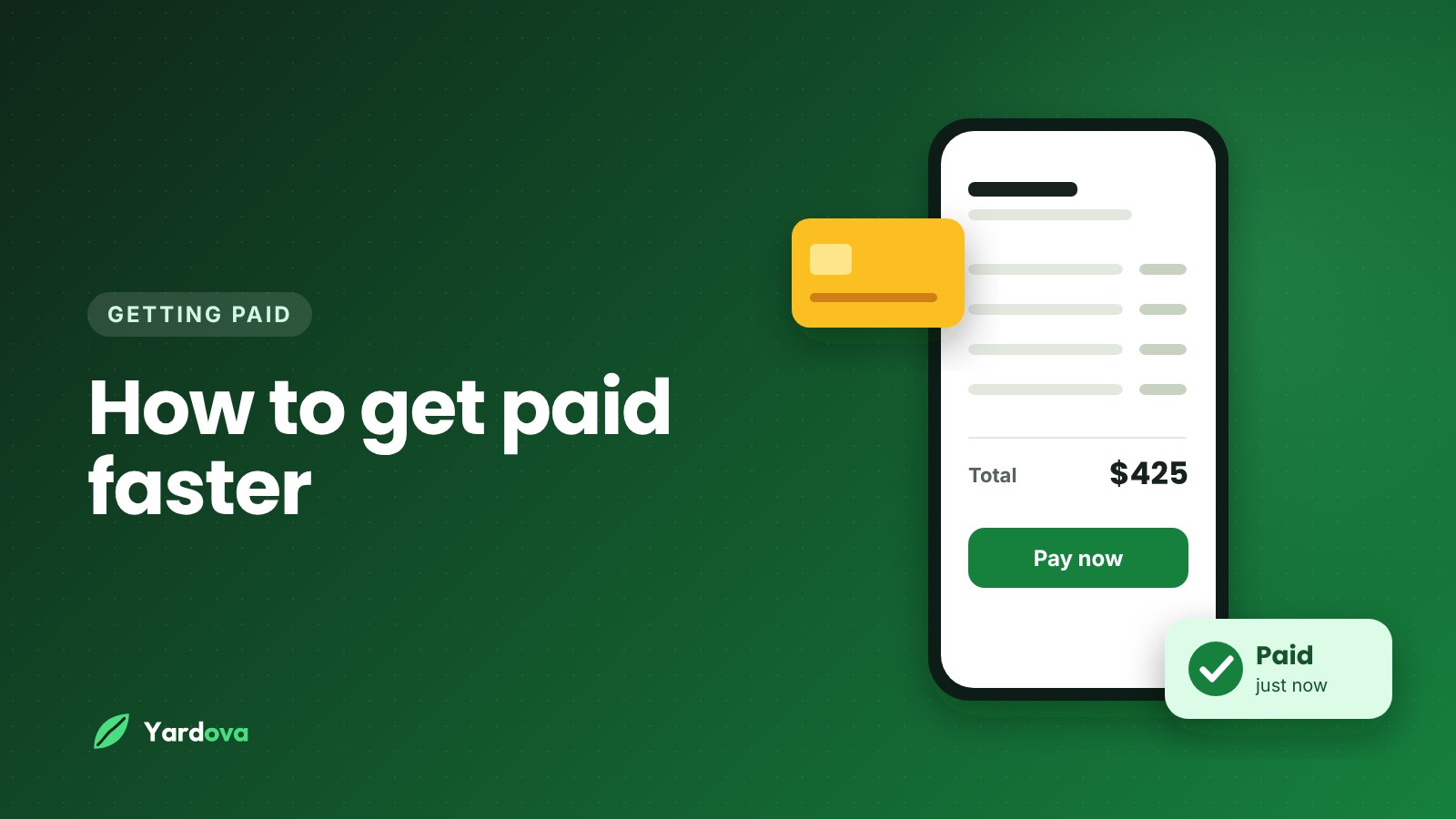
If you want to get paid faster, the fix usually is not chasing customers harder. It is making payment so easy and so automatic that most people pay before you would even think about following up.
Late payments are rarely about customers who refuse to pay. They are about invoices that went out late, were confusing, were buried in an inbox or could only be paid by check. Each of those is a small delay, and together they turn a finished job into money you see three or four weeks later.
For a small home-service business, that gap matters. You have already paid for fuel, dump fees, materials and wages. Every day the invoice sits unpaid, you are financing your customer's yard, house or driveway out of your own pocket.
This guide covers ten practical ways lawn care, cleaning, junk removal, pressure washing, painting, pest control, pool service and trade businesses close that gap. Most of them take an afternoon to set up and then run on their own.
Why customers pay late, and how to get paid faster
Before fixing the problem, it helps to know where the delays actually come from. In most small service businesses, slow payment comes down to a handful of causes:
- The invoice went out late. The owner meant to send it the same day, but it waited until Friday night, or the end of the month.
- The customer did not see it. An email landed in a promotions folder or a spam filter.
- Paying was a hassle. The customer had to find a checkbook, an envelope and a stamp, or call in a card number.
- The invoice was confusing. It was unclear what it was for, what was owed or when it was due.
- Nobody followed up. Following up feels awkward, so it does not happen until the invoice is 60 days old.
- Terms were never set. The customer honestly did not know you expected payment on completion.
Notice that almost all of these are on the business side, not the customer side. That is good news. It means you control most of what it takes to get paid faster.
1. Set clear payment terms before the work starts
The easiest time to talk about payment is before the job, not after. When a customer approves a quote, they should already know how and when they will pay.
Common invoice payment terms for service businesses
Pick terms that fit your trade and put them in writing:
- Due on completion. Common for one-time jobs like junk removal, cleanups and pressure washing.
- Due within 7 days. Works for larger jobs or customers who need a few days to pay.
- Deposit at approval, balance on completion. Common for painting, tree work, installs and big cleanouts.
- Autopay after each visit or monthly. Best for recurring lawn, cleaning, pool and pest control customers.
Avoid long terms like "net 30" unless you are working with commercial accounts that require them. For homeowners, shorter terms are normal and expected.
Where to put your terms
Put the same terms in three places: on the quote, in the approval message and on the invoice. When the expectation is set up front, asking for payment later is not awkward. You are just doing what you both agreed to.
If you want help writing quotes that spell this out clearly, see our guide on how to write a quote for a service business.
2. Send the invoice the same day
The longer you wait to invoice, the longer you wait to get paid. An invoice sent while the customer is looking at a fresh lawn, a clean garage or a bright driveway gets paid much faster than one sent a week later, after the job has faded from memory.
Make invoicing part of finishing the job
Build the invoice into your closing routine rather than treating it as office work:
- Crew finishes the work and takes after photos.
- Crew marks the job complete.
- The invoice is created from the job details and sent right away, by the crew or by you from your phone.
- The customer gets a text with a pay link before your truck leaves the street.
If you are still writing invoices from memory at the end of the week, this one change alone can help you get paid faster than anything else on this list.
Take payment before you leave
When the customer is home, the fastest payment is the one collected on the spot. Have the crew lead or tech walk the customer through the finished work, show the after photos and mention that the invoice was just texted to them. Many customers will pay right there on their phone while you are standing in the driveway.
This works especially well for one-time jobs like junk removal, gutter cleaning and pressure washing, where the result is obvious and the customer is happy with it. A simple line like "I just sent your invoice by text, you can pay with your card or Apple Pay whenever you are ready" is enough. No pressure, just a clear next step.
Do not batch small invoices
It is tempting to save up a week of small jobs and send them all at once. Resist it. Small invoices are the easiest to pay on the spot and the easiest to forget when they show up days later.
3. Text the invoice, do not just email it
Email still has its place, but texts get read. Most customers look at a text within minutes. An emailed invoice might sit unopened for days.
Example invoice text message
Here is a simple invoice message you can copy and adapt:
Hi Tom, thanks for having us out today. Here is your invoice for the spring cleanup at 18 Birch Lane: [link]. You can pay by card, Apple Pay or Google Pay right from your phone. Thank you for your business!
Keep it short, friendly and specific. Name the job and the address so the customer knows exactly what it is for. Put the link where it is easy to tap.
Sending both a text and an email works well. The text gets attention, and the email gives the customer a copy for their records.
If you text customers, get their permission when they book and follow the current texting rules where you operate. Rules change, so it is worth checking them every so often.
4. Get paid faster by accepting cards on every invoice
This is the biggest single lever for most businesses that want to get paid faster. People will tap a button much sooner than they will write a check.
What to offer
Every invoice should have a clear Pay now button that accepts:
- Credit and debit cards
- Apple Pay
- Google Pay
Many customers will pay within minutes of receiving the text, often while the crew is still loading the trailer.
What about card processing fees?
Card processors charge a small percentage of each transaction. Check your processor's current rates. Most owners find the fee is worth it compared with the cost of waiting weeks for checks, driving to the bank and chasing late payers. You can also account for it in your pricing.
Some businesses add a surcharge for card payments. Rules on surcharging vary by state and by card network, so check the current requirements before doing it.
Offer other ways to pay, too
Some customers prefer Venmo, Zelle, PayPal, Cash App or Square. Listing the options you accept on every invoice removes one more reason to wait. Cards are usually the fastest, but meeting people where they already are helps the stragglers pay sooner.
5. Collect deposits for service businesses on larger jobs
For bigger jobs, ask for a deposit when the customer approves the quote. This is standard practice for painting, tree removal, installs, landscaping projects, large cleanouts and anything with significant materials.
Why deposits help you get paid faster
- You collect part of the money before the job even starts.
- Your time is protected. A customer who has paid a deposit is far less likely to cancel or no-show.
- Materials are covered. You are not fronting the cost of mulch, paint or parts.
- The final balance is smaller, so it is easier for the customer to pay on the spot.
How much of a deposit to ask for
A deposit of around 25 percent is common for many home-service jobs. Larger projects or jobs with expensive materials often use a higher deposit, and some owners use a flat amount for smaller work. For example, if a cleanout is quoted at $800, a 25 percent deposit would be $200 at approval and $600 on completion.
The smoothest setup lets the customer approve the quote and pay the deposit in the same step, online, in a minute or two. Every extra step between "yes" and "paid" is a chance for the deal to stall.
6. Use autopay for recurring customers
If you run weekly mowing, every-other-week cleaning, pool service or pest control plans, autopay is the single best way to stop chasing small invoices.
How autopay works for service businesses
- The customer saves a card on file when they sign up.
- You choose whether to charge after each visit or once a month.
- The card is charged automatically, and the customer gets a receipt.
- You only step in when a card is declined or expires.
Two common autopay setups
- Charge after each visit. Simple and clear. The customer sees a charge each time the work is done.
- Monthly plan. The customer pays one set amount each month. This smooths out cash flow for both of you and is popular for lawn care, pool and pest control.
Make autopay the default
When you sign up a new recurring customer, present autopay as the normal way you work: "We keep a card on file and charge after each visit, so you never have to think about it." Most customers appreciate not having another bill to remember, and you get paid faster on every visit without lifting a finger.
What to do when an autopay card declines
Cards expire and get replaced, so a few declines each season are normal. Handle them quickly and without drama:
- Send the customer a short text with a link to update their card.
- Keep the visit on the schedule unless the balance keeps growing.
- If the card is not updated within a week or two, call them.
- Note it on the customer record so you can spot repeat problems.
Most declines are fixed in a day once the customer knows about them.
For lawn care businesses especially, autopay turns a season of dozens of tiny invoices into money that just shows up. See our lawn care software and pool service software pages for how recurring billing fits into a route-based business.
7. Make your invoices impossible to misunderstand
Confusing invoices get set aside "to deal with later." Clear ones get paid.
Invoice checklist
Before an invoice goes out, check that it includes:
- Your business name, logo, phone number and email
- The customer's name and the service address
- The date of service
- What was done, in simple line items a homeowner understands
- Any deposit already paid, clearly subtracted
- Subtotal, tax and total, each shown separately
- The due date in plain words
- A clear Pay now button or link
- Other payment methods you accept
- A short thank-you note
Line items that make sense
"Services rendered, $450" invites questions. "Spring cleanup: leaf removal, bed edging, haul away 3 yards of debris, $450" does not. Specific line items reassure customers they are paying for what they saw. Clear invoices are a quiet way to get paid faster, because there is nothing to question before paying.
Adding a before and after photo to the job record also helps. If a customer ever questions an invoice, you can show exactly what was done.
8. Send payment reminders automatically
Following up on unpaid invoices is uncomfortable, so most owners put it off. Automatic reminders do it for you, politely and on schedule. Most late payers simply forgot, and a reminder with a pay link is all they need.
A simple reminder schedule
For an invoice due on completion, a schedule like this works for many businesses:
- 3 days after the due date: a friendly reminder with the pay link.
- 7 days after the due date: a second reminder, still friendly.
- 14 days after the due date: a firmer note, and a personal call from you.
Adjust the timing to fit your terms, but keep the first reminder early. The sooner you nudge, the more likely the customer still remembers the job.
Payment reminder template
Hi Sarah, just a quick reminder that your invoice for the house wash on May 12 is still open. You can pay here in about a minute: [link]. If you have already paid, thank you, and please ignore this message.
Keep reminders short and assume good intent. A friendly tone keeps the customer coming back, and consistent, early reminders are one of the most reliable ways to get paid faster on the invoices that do slip.
9. Know who owes you at a glance
You cannot follow up on what you cannot see. If your unpaid invoices are scattered across a notebook, a spreadsheet and your text messages, some will slip through.
Keep one list of open invoices
Keep a single list of unpaid invoices, sorted by how long they have been outstanding. Check it at least once a week. Look for:
- Anything more than a week past due
- Repeat customers who are consistently late
- Large balances that need a personal call
- Declined autopay cards that need updating
A weekly ten-minute review catches problems while they are still small. It also gives you a realistic picture of cash coming in over the next couple of weeks, which makes it easier to plan payroll, equipment purchases and slow months.
Track your revenue and where it comes from
It also helps to look at revenue reports by month and by lead source. If one type of job or one source of customers is always slow to pay, you can adjust your terms for that work, such as requiring a deposit.
10. How to collect unpaid invoices that are seriously late
Even with all of this in place, a few invoices will drag on. Here is a calm, step-by-step way to handle them.
- Call the customer. A friendly phone call clears up most stuck invoices. Often there is a simple issue, like a question about a line item or a card that expired.
- Offer an easy way to pay right now. Send the pay link again while you are on the phone.
- Offer a short payment plan if the amount is large and the customer is struggling. Getting paid in two or three parts beats not getting paid.
- Put it in writing. Send a clear written notice with the amount, the job and a final due date.
- Pause future work until the balance is paid. Be polite but firm.
- Consider next steps for large amounts, such as small claims court or a collection agency. Rules and options vary by state, so check what applies to you.
Late payment tips to prevent repeats
- Require a deposit or card on file for any customer who has paid late before.
- Switch late-paying recurring customers to autopay.
- If you want to charge late fees, state them clearly on your quotes and invoices up front, and check your state's rules on late fees first.
Frequently asked questions
How can a service business get paid faster?
A service business can get paid faster by sending invoices the same day, texting a pay link that accepts cards and mobile wallets, collecting deposits on larger jobs and putting recurring customers on autopay. Automatic payment reminders handle the rest. Together, these remove most of the reasons customers wait to pay.
How do I get customers to pay invoices faster without being pushy?
Make paying easy and set expectations up front, and you rarely need to push. Put your payment terms on the quote, send the invoice by text right after the job and include a one-tap pay button. Friendly automatic reminders do the follow-up, so you never have to send an awkward message yourself.
What payment terms should a small service business use?
Most small home-service businesses use "due on completion" for one-time jobs and autopay for recurring work. Larger projects often use a deposit at approval with the balance due on completion. Long terms like net 30 are usually only needed for commercial accounts.
How much deposit should I ask for on a service job?
A deposit of around 25 percent is common for many home-service jobs, though larger projects or material-heavy work often use more. Some businesses use a flat deposit for smaller jobs instead. Whatever you choose, collect it when the customer approves the quote.
Should I pass card fees on to customers?
You can, but you are not required to, and many owners simply build card fees into their pricing. If you do add a surcharge, rules vary by state and card network, so check the current requirements first. Either way, the speed of card payments usually outweighs the fee.
When should I send a payment reminder?
Send the first payment reminder a few days after the due date, while the job is still fresh in the customer's mind. A second reminder about a week later and a personal call after two weeks is a reasonable schedule. Automating the first two saves you from having to remember.
Wrap-up: get paid faster without chasing anyone
To get paid faster, set clear terms before the work starts, invoice the same day, text a pay link, accept cards and mobile wallets, collect deposits on big jobs, put recurring customers on autopay and let automatic reminders handle the follow-up. Each step removes one reason for a customer to wait.
Yardova handles all of that from your phone. Invoices go out by text or email with card, Apple Pay and Google Pay, and customers pay through your own Stripe account, so the money goes to your bank. You can also show PayPal, Venmo, Cash App, Square or Zelle on invoices, take a deposit when a quote is approved, save cards for autopay after each visit or on monthly plans, and let payment reminders go out automatically.
Start a free Yardova account, compare plans and pricing or book a demo. And since faster payment starts with a full schedule, read our guide to crew scheduling for service businesses and see how to get more Google reviews from every finished job.