How to Write a Quote That Wins the Job (Free Template)
Learn how to write a quote for a home service job that's clear, professional and easy to say yes to, with a free template and examples to copy.
The Yardova team · October 28, 2026 · 14 min read
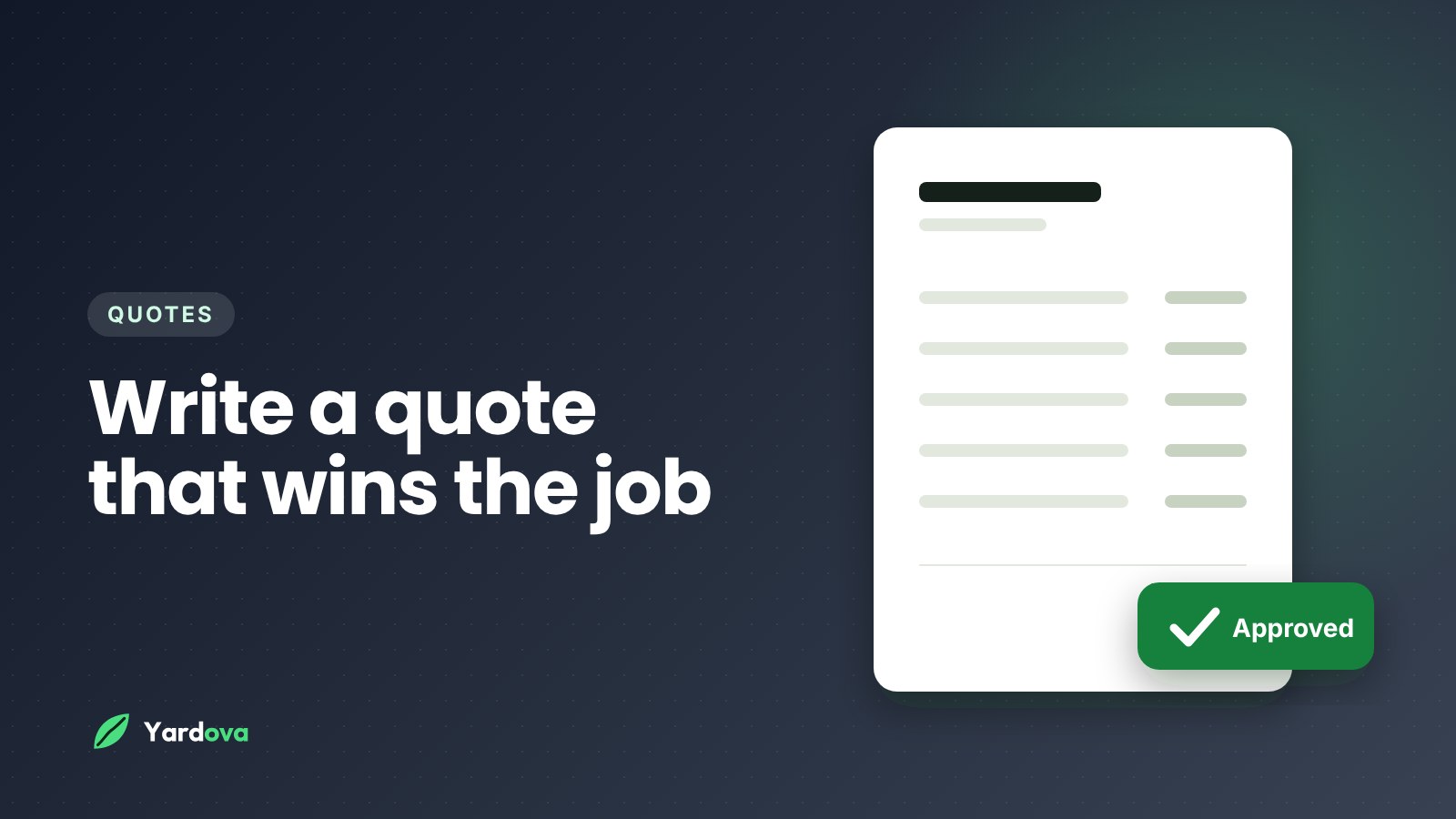
Knowing how to write a quote well wins you jobs that a cheaper competitor would otherwise get. Homeowners rarely pick the lowest number on its own. They pick the company that seems clear, trustworthy and easy to deal with, and your quote is often the first real impression they get of how you work.
This guide covers everything that goes into a quote for a home service business: what to include, how to price and present the job, how to write the scope in plain words, examples for different trades, a copy-paste template, and how to follow up when the customer goes quiet. It works for lawn care, cleaning, junk removal, pressure washing, painting, handyman work and most other trades.
Why your quote matters more than your price
Most owners think they lose jobs on price. Sometimes that's true. But just as often the job goes to the company that answered first, explained the work clearly and made it easy to say yes.
Think about it from the homeowner's side. They have three quotes on their phone:
- One is a single number in a text: "$900."
- One is a PDF that arrived five days later with no detail.
- One arrived the same afternoon, lists exactly what will be done, shows what's included, and has a button to approve.
Even if the third one costs a bit more, it's the one that feels safe. That's why learning how to write a quote is worth the time. A good quote reduces the customer's risk, and people pay for less risk.
Quote vs estimate: what's the difference?
People use the words loosely, but it helps to be clear with your customers about which one you're sending.
- An estimate is a rough idea of the cost. It can change once you see the job or start the work. "Somewhere between $300 and $450, depending on what's under the deck."
- A quote is a firm price for a defined scope of work. If the scope stays the same, the price stays the same.
Many service businesses send a range first, often from photos, and then a firm quote once they've seen the job. That's a smart approach. Just label each one clearly, and say what would change the price. Customers get upset when a "quote" turns out to be a guess.
What to include in a quote
The first rule of how to write a quote is that it should answer the customer's questions before they have to ask them. Here's what to include:
- Your business name and contact details, plus your logo if you have one.
- The customer's name and the service address.
- The quote date and an expiration date, such as 30 days.
- A short job title that says what the job is, like "Spring cleanup and mulch" or "Move-out deep clean."
- Line items that break the work into clear pieces, each with a price.
- What's included, like haul-away, cleanup or materials.
- What's not included, so nobody argues later.
- The schedule, or at least when you can start.
- The total, with any tax shown separately.
- Payment terms: deposit, when the balance is due, and how they can pay.
- How to say yes, ideally one tap or one reply.
If you're licensed or insured in a way customers care about, mention it. A single line like "Fully insured" or your license number where your trade requires one adds trust without clutter.
How to write a quote step by step
Here's how to write a quote the same way every time, so nothing gets missed and your quotes look consistent no matter who on your team sends them.
- Get the details. Collect the address, what the customer wants, any deadline, and photos of the job. Ask what matters most to them.
- Look at the job. Visit in person or review the photos and satellite view. Note anything that makes the job harder, like stairs, steep slopes, pets or tight access.
- Price each part of the work. Use your saved price list for standard items and your cost method for anything custom.
- Write the line items. Describe each piece of work in plain words, with quantities where they help.
- Add what's included and what's not. Head off the obvious questions.
- Set the terms. Add the expiration date, deposit, payment timing and how to pay.
- Read it as the customer. Would someone with no trade knowledge understand every line?
- Send it fast. Same day if you can, by text with a link to view and approve.
- Schedule the follow-up. Put a reminder on the calendar before you forget.
How to price the job before you write the quote
A clear quote with the wrong number still loses money. Before you write anything, know how you'll price the work.
Know your cost per hour
Add up what it costs to run a crew for an hour: wages and payroll taxes, truck and equipment costs, fuel, insurance and a share of overhead. Every price you quote needs to clear that number with room to spare. If you don't know it, start there.
Use a saved price list for standard work
Most service businesses do the same handful of jobs over and over. Weekly mowing by lot size. A standard house wash by square footage. A move-out clean by bedrooms and bathrooms. A quarter-truck of junk.
Put those prices in one list and quote from it every time. It's faster, it keeps your crew consistent, and it stops you from talking yourself into a discount because a customer sounded nice on the phone.
Price custom work by time and materials
For jobs that don't fit your list, estimate the hours, multiply by your hourly rate, add materials with a markup, add disposal if there is any, and round to a clean number. Then sanity-check it against what similar jobs have brought in before.
If you haul junk, our guide on how to price junk removal walks through a full pricing method with examples.
How to present the price
When you think about how to write a quote, how you show the number matters almost as much as the number itself. These habits make the same price easier to accept.
Break the price into line items
A single total like "$850" makes customers wonder what they're paying for. Line items such as "Remove leaves from front and back yard: $220" and "Edge and mulch front beds, 6 yards of mulch: $480" show your thinking and make the price feel earned.
Line items also make it easy to drop one piece if the customer wants to spend less, instead of losing the whole job.
Offer good, better, best options
Two or three versions of the job let customers choose between options instead of deciding yes or no. For example, a house cleaning quote might offer:
- Standard clean: kitchen, bathrooms, dusting, floors.
- Deep clean: everything in standard, plus baseboards, inside the microwave and detailed bathroom scrubbing.
- Move-out clean: everything in deep, plus inside cabinets, inside the oven and inside the fridge.
Many customers pick the middle option. Keep it to three choices at most, and make the differences obvious. Too many options slows people down.
Show deposits and payment terms clearly
If you take a deposit, state the amount and when it's due, usually at approval. A deposit of around 25 percent is common for bigger jobs and materials-heavy work, and it cuts down on cancellations. For smaller recurring work, many businesses skip deposits and keep a card on file instead.
Say how they can pay: card, bank transfer, check, or the payment apps you accept. If customers can pay online, say so. Our guide on how to get paid faster covers payment terms in more depth.
Round, don't nickel-and-dime
"$487.63" looks like you ran it through a calculator and want every cent. "$485" or "$490" looks confident. Round line items and totals to clean numbers unless your trade expects exact material pricing.
Write the scope in plain language
The scope is the description of the work, and it's the part of how to write a quote that most owners rush. It's where most disputes start, and where a well-written quote earns its keep.
Use the customer's words
If they asked for "the weeds by the fence gone," say exactly that in the quote. It shows you listened, and it makes the quote easy to understand at a glance. Save trade terms for your crew notes.
Be specific about quantities and areas
"Pressure wash driveway" leaves room for argument. "Pressure wash front driveway and front walkway, about 900 square feet, including oil stain treatment" doesn't. Name the rooms, the beds, the surfaces or the number of items.
Say what's not included
Exclusions protect you and the customer. Common examples:
- "Does not include painting of trim or doors."
- "Does not include items inside the shed."
- "Mulch beds in back yard not included."
- "Interior windows not included."
One or two lines here prevent the most common "I thought that was included" phone calls.
Note assumptions and what could change the price
If the price depends on something you can't see, say so. "Price assumes no rotted wood under the existing deck boards. Any repairs will be quoted separately before work begins." This is honest, and it gives you a clean way to handle surprises.
How to write a quote: examples by trade
Here's what line items look like for a few common trades. All prices are made-up examples, not recommendations.
Lawn care quote example
- Weekly mowing, edging and blowing, front and back yard: $45 per visit
- Spring cleanup, remove leaves and debris from all beds: $180
- Edge and mulch front beds, about 4 yards of brown mulch: $340
- Included: haul-away of all debris, blowing off driveway and walks
- Not included: back yard beds, shrub trimming
House cleaning quote example
- Deep clean, 3 bedrooms and 2 bathrooms: $320
- Inside oven and inside fridge: $60
- Included: all supplies and equipment
- Not included: interior windows, laundry
Pressure washing quote example
- House wash, two-story vinyl siding, all four sides: $375
- Driveway and front walkway, about 900 square feet: $180
- Included: rinse of plants and windows, gutter face brightening
- Not included: deck or fence
Junk removal quote example
- Garage cleanout, estimated half truck: $375 to $425
- Mattress disposal fee: $40
- Included: loading, hauling, disposal and sweep-up
- Final price confirmed on site before work starts
A copy-paste quote template
Copy this and fill in your own details. It works by text, email or as a printed sheet.
[Your business name]
[Phone] · [Email] · [Website]
Quote for: [Customer name], [Service address]
Date: [Date] · Good for: 30 days
[Job title]
[Task 1, described in plain words]: $[price]
[Task 2]: $[price]
[Task 3]: $[price]
Included: [haul-away, cleanup, materials, etc.]
Not included: [anything they might assume is included]
Schedule: [Start date or "within X days of approval"]
Subtotal: $[amount] · Tax: $[amount] · Total: $[amount]
Deposit: $[amount] due at approval. Balance due when the job is complete.
Next step: Reply YES or tap the link to approve, and we'll get you on the schedule.
Mistakes to avoid when you write a quote
Even a well-priced job can be lost to a sloppy quote. Watch for these:
- Sending only a total. Customers can't compare what they can't see.
- Leaving out exclusions. Every missing "not included" line is a future argument.
- Using trade jargon. "Dethatch and overseed" means little to most homeowners; "rake out dead grass and plant new seed" means a lot.
- No expiration date. Without one, a customer can come back months later expecting last year's price.
- Making approval hard. If saying yes takes more than a tap or a reply, some people won't bother.
- Waiting too long. A great quote that arrives after the customer hired someone else wins nothing.
Quote checklist before you hit send
Run every quote through this quick checklist:
- The customer's name and address are correct.
- The job title says what the job is in a few words.
- Every line item is described in plain language with a price.
- Quantities, areas or rooms are named where they matter.
- What's included and what's not are both listed.
- Tax is shown separately where it applies.
- The expiration date is set.
- The deposit and payment terms are clear.
- There's one obvious way to say yes.
- You've read it once as if you were the customer.
Send the quote fast
Speed matters as much as the quote itself. A quote that arrives the same day, while the customer is still thinking about the job, has a much better chance than a perfect one that shows up next week.
Quote from photos when you can
Asking customers to send photos lets you quote many jobs without a separate trip. Lawns, junk piles, driveways, gutters and rooms to paint can often be quoted from a few good pictures plus a satellite view. Send a range or a firm price, and note that the final price will be confirmed on site if anything looks different.
The best way to send a quote
Knowing how to write a quote is only useful if it reaches the customer while they still care. Text is usually the fastest. People read texts quickly, and a link lets them see the full quote and approve it right from their phone. Email works well too, especially for larger jobs where the customer wants to forward it to a spouse or a property manager. Whichever you use, make approving easy: one tap or one reply, not "print, sign and scan."
A short message with the link helps:
Hi [Name], thanks for having us out today. Here's your quote for the spring cleanup and mulch: [link]. You can approve it right from that page, and we'll get you on the schedule for next week. Any questions, just reply here.
How to follow up on a quote
Many quotes that go unanswered aren't a no. The customer got busy, wanted to talk to their spouse, or forgot. Knowing how to write a quote gets you halfway; a polite follow-up wins back a lot of the rest.
A simple follow-up schedule
- Day 2 or 3: A friendly check-in asking if they have questions.
- Day 7: A short reminder that mentions your schedule is filling up, if it's true.
- A few days before expiration: A note that the quote expires soon, with the link again.
- After that: Mark it lost, note the reason if you know it, and move on.
Follow-up message examples
Hi [Name], just checking in on the quote we sent for [job]. Happy to answer any questions or adjust anything. Here's the link again: [link].
Hi [Name], quick heads-up that your quote for [job] is good through [date]. We have openings next week if you'd like to get on the schedule.
Keep it short and friendly. Never guilt the customer or push hard. The goal is to make it easy for them to say yes, or to tell you no so you can stop following up.
Learn from the quotes you lose
When a customer says no, ask why in one friendly line. Price, timing, scope or they went with someone they already knew? Track the answers. If most of your losses are price, check your numbers. If most are timing, you're probably slow to respond.
Frequently asked questions
How do you write a quote for a service business?
Write a quote by listing your business details, the customer's name and address, a short job title, line items with prices, what's included and not included, the total with tax, the expiration date, payment terms and a clear way to approve. Use plain language and the customer's own words. Send it the same day if you can, and follow up after two or three days.
What should be included in a quote?
A quote should include your business name and contact details, the customer and service address, the date and expiration, line items with prices, inclusions and exclusions, the schedule, the total with tax shown separately, payment and deposit terms, and how to accept. Anything a customer might ask before saying yes belongs in the quote.
What is the difference between a quote and an estimate?
A quote is a firm price for a defined scope of work, while an estimate is an approximate cost that may change. Many service businesses send an estimate or price range first, often from photos, then a firm quote once they've seen the job. Label each one clearly so customers know which they're getting.
How long should a quote be valid?
Thirty days is a common expiration for home service quotes. Shorter periods, like 14 days, make sense when material prices change quickly or your schedule fills fast. Always put the expiration date on the quote so the customer knows when the price may change.
How soon should I follow up on a quote?
Follow up two or three days after sending the quote with a short, friendly check-in. A second reminder around a week later and a final note before the quote expires is usually enough. After that, mark it lost and move on.
Should I ask for a deposit on a quote?
Ask for a deposit on larger jobs, jobs with significant materials, and jobs booked far in advance. A deposit of around 25 percent is common in many trades, collected when the customer approves the quote. Small recurring jobs often don't need one, especially if you keep a card on file.
Wrap-up: how to write a quote that gets a yes
Once you know how to write a quote with clear line items, plain-language scope, honest exclusions, a fair expiration date and an easy way to say yes, and you send it fast and follow up kindly, you'll win more jobs at the prices you need.
To recap:
- Price the job from your real costs or a saved price list.
- Break the price into line items, and offer options when it fits.
- Say what's included and what isn't.
- Send it the same day by text or email with one-tap approval.
- Follow up on a schedule, and learn from the quotes you lose.
Yardova handles most of this for you. You build quotes from a saved price list, or have Yardova's AI draft one from a short description for you to review. Quotes go out by text or email, customers approve them online in one tap with an optional deposit, and daily AI follow-up drafts remind you about quotes that haven't been answered. It works for lawn care, cleaning, pressure washing and other trades.
Start a free Yardova account to send your next quote in a couple of minutes, book a demo to see it first, or compare plans and pricing. For more ways to fill your schedule, read how to get more lawn care customers.