How Much to Charge for Snow Removal: A Plow Pricing Guide
Learn how much to charge for snow removal: per push, per inch, per event and seasonal pricing, cost per truck hour, salting, contracts and billing.
The Yardova team · 5 de noviembre de 2026 · 16 min de lectura
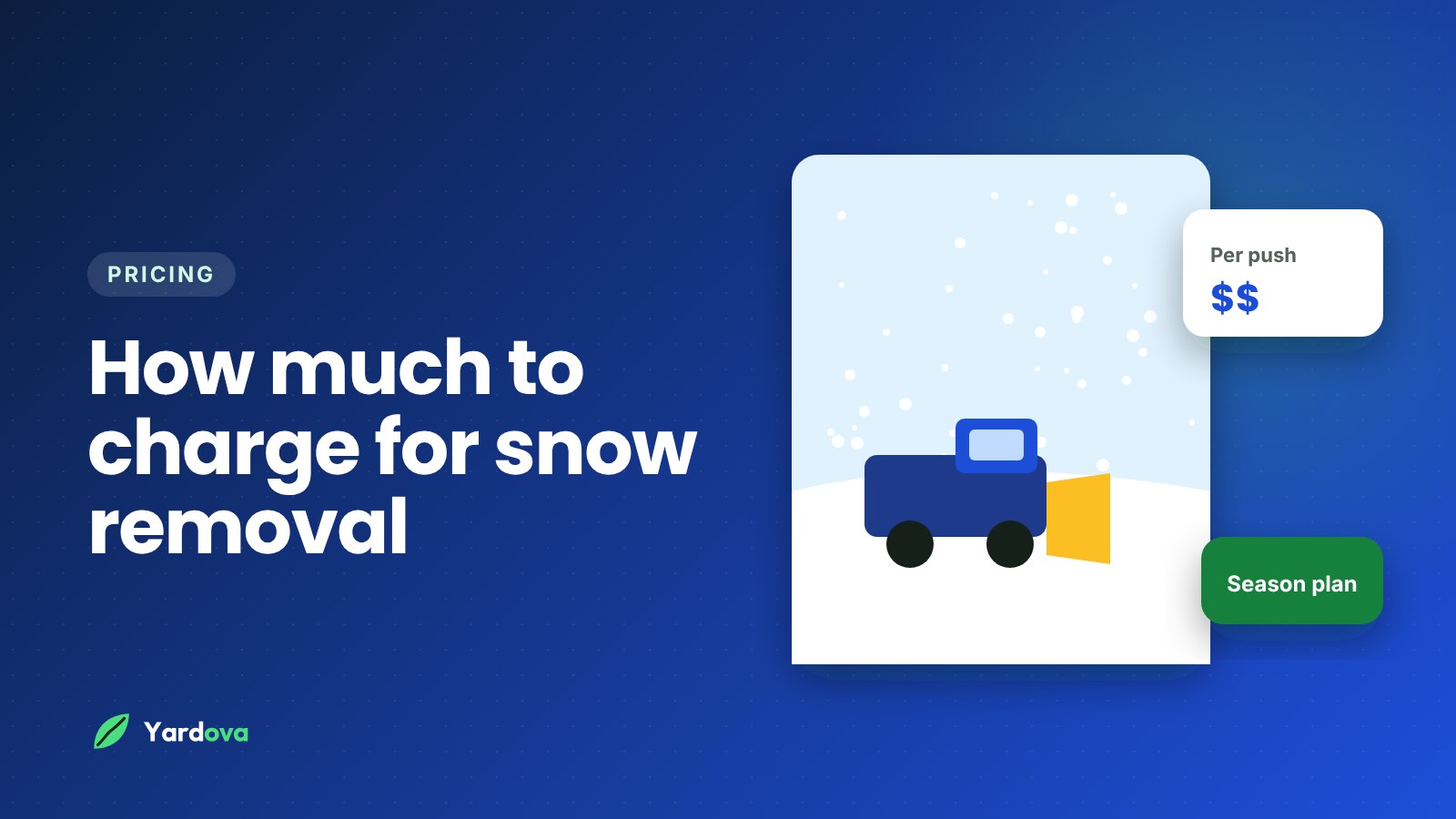
Knowing how much to charge for snow removal comes down to three things: what a truck hour actually costs you, how much weather risk you are willing to carry, and how tightly you can pack your route. Get those right and the per-driveway or per-lot number almost writes itself.
This guide is for lawn and landscape companies adding winter work to keep crews busy, and for new plow operators pricing their first season. It covers the common pricing methods, a worked cost-per-hour example, residential versus commercial pricing, salting, contracts, billing and the messages you send before and during a storm.
One note before the numbers: snow plowing prices vary widely by region, by town and even by neighborhood. Every dollar figure below is a labeled example to show the math, not a market rate.
Snow removal pricing methods and how each shifts risk
Every snow pricing method is really a decision about who carries the weather risk. In a heavy winter, someone pays for all those extra pushes. In a light winter, someone pays for equipment that sat in the yard. Part of deciding how much to charge for snow removal is picking those methods on purpose.
Per push or per visit pricing
With per push pricing, you charge a set amount every time you plow a property. Two pushes in one storm means two charges.
- Risk: mostly on the customer. A big winter means a big bill for them and steady revenue for you.
- Best for: residential driveways and small lots where the work per visit is predictable.
- Watch out for: sticker shock after a snowy month. Tell customers at signup how many pushes a long storm can take.
Per inch tiers and trigger depths
Per inch pricing ties the charge to how much snow fell. You set a trigger depth (the minimum snowfall before you show up) and price in tiers.
- Example tiers: 2 to 4 inches, 4 to 8 inches, 8 to 12 inches, and anything over 12 inches quoted hourly.
- Heavier snow takes longer, strains equipment and often needs a second pass, so tiers keep your pay in line with the work.
- Risk: shared. The customer pays more for big storms, and you are not stuck plowing 14 inches at a 3-inch price.
Write down how depth is measured, such as a nearby official weather report or your own measurement on site, so there is no argument later.
Per event pricing
Per event pricing charges once per storm, no matter how many pushes it takes to keep the property open. Define what an "event" is, for example snowfall separated from the next one by a set number of dry hours.
- Risk: on you during long storms. A two-day storm that needs four visits still pays one event price.
- Best for: commercial customers who want a predictable cost per storm.
- Price it high enough to cover extra visits, and add a higher tier for storms above a set depth.
Hourly pricing for equipment
Hourly pricing charges for the time a machine and operator spend on site. A plow truck, a skid steer with a pusher box, a loader and a shoveler with a snowblower each get their own rate.
- Risk: mostly on the customer, since every hour is paid.
- Best for: large or irregular lots, snow relocation and hauling, and storms above your top tier.
- Record start and stop times on the invoice. Property managers will ask.
Seasonal contracts: capped or unlimited
A seasonal snow removal contract charges a flat price for the whole winter, paid up front or in monthly installments.
- Unlimited seasonal: one price covers every push. A light winter pays well; a heavy one can lose money. The risk sits with you.
- Capped seasonal: one price covers up to a set number of pushes, then each extra push is billed at a set rate. This shares the risk and is a safer start for newer companies.
- Minimum plus overage: a smaller base fee guarantees you a minimum, with pushes beyond a set count billed separately.
Seasonal money arrives whether it snows or not, which is what pays truck notes and insurance in a dry December. Base the price on your own records of past winters, not one season's memory.
Snow plow cost per hour: a worked example
Before you decide how much to charge for snow removal, you need your real cost to run one truck for one billable hour. Most new operators skip this, and it is the number that decides whether a winter makes money.
Split costs into fixed costs you pay all season whether it snows or not, and running costs that only happen when the truck is out.
Fixed costs for the season (example numbers)
These are example numbers to show the math. Replace each with your own.
- Truck payment or depreciation share for the winter: $6,000
- Plow cost spread over its useful life, plus mounting: $2,000
- Winter share of vehicle and liability insurance: $3,500
- Pre-season maintenance, blade edges, hoses, lights, spare parts: $1,500
- Phone, software and marketing: $1,000
Example fixed total: $14,000. Now estimate the billable plowing hours one truck runs in a normal winter, conservatively and from your own experience. This example uses 175 hours.
$14,000 divided by 175 hours = $80 per billable hour in fixed cost.
Running costs per hour (example numbers)
- Fuel: about 2 gallons an hour at $4 a gallon = $8
- Wear on the plow, transmission, tires and brakes = $12
- Driver pay, including payroll taxes and night overtime = $35
- Standby time, the hours you pay drivers to wait for snow, spread across billable hours = $8
Example running total: $63 per hour.
Putting it together
Fixed $80 plus running $63 = $143 per billable truck hour. That is your break-even.
Now add margin for overhead you did not count (office time, slow payers, a broken plow mid-storm) and for profit. With a 25 to 35 percent margin, a range many operators aim for, the target in this example lands around $180 to $195 per truck hour.
Notice what moves the number most: billable hours. If a light winter only gives you 100 hours, fixed costs alone become $140 an hour. That is exactly why seasonal contracts and minimums exist.
How much to charge for snow removal on residential driveways vs commercial lots
Residential and commercial work look similar from the cab, but the expectations, risks and timing are different, so the pricing is too.
Residential driveway snow removal cost
Residential driveways are usually priced per push or as a capped seasonal contract. To set a per push price, convert your hourly target into minutes.
- Time each driveway, including the drive from the previous stop and cleaning out the berm the city plow leaves at the end.
- Multiply by your per-minute rate. At $185 an hour, that is about $3.08 a minute.
- A driveway that takes 10 minutes door to door is about $31 per push. One that takes 18 minutes is about $55.
Add for long or steep driveways, gravel, tight turnarounds and parked cars. Homeowners mostly care about getting out for work, so your service window matters as much as your price.
Commercial snow plowing rates
Commercial lots (retail plazas, offices, medical buildings, churches, HOAs) carry more liability, tighter deadlines and more paperwork, so the question of how much to charge for snow removal on these properties starts with risk and timing.
- Measure the lot and note islands, curbs, light poles, fire lanes, loading docks and pile areas.
- Ask about hours. An office that opens at 7 a.m. may need plowing at 3 a.m. and a cleanup pass later.
- Quote whatever structure the property manager wants: per push, per inch, per event, hourly or seasonal.
- Price pile relocation and hauling separately as hourly equipment work.
Commercial customers often pay on longer terms, so plan for that cash gap.
How to price salting, de-icing and sidewalk shoveling
When owners figure out how much to charge for snow removal, the most common mistake is bundling salt and shoveling into the plow price. Keep them separate. They have different costs, timing and liability.
Sidewalks and shoveling
Walks take labor, not trucks. A shoveler costs less per hour than a plow truck, but the work is slow and has to be careful.
- Price walks per visit, by linear foot, or per hour for a shoveler.
- Note stairs, ramps, entryways and accessible parking spots separately.
- For homeowners, a simple add-on works: "front walk and steps, $X per visit."
How to price salting and de-icing
Salt and ice melt prices can swing during a season, so price them in a way that protects your margin.
- Per application: a flat price each time you salt. Simple for homes and small lots.
- By the bag: a charge per bag of ice melt plus labor. Common for walks and entries.
- By area or weight: for larger lots, price by square footage covered or bulk salt spread, plus a trip charge.
Spell out when salting happens: after every plow, on request, or when conditions call for it. Freezing rain and refreeze visits with no plowing should be billable too. Log the date, time and amount for every application, since that record matters for billing and liability.
Route density and the order you plow
Route density is the hidden lever in snow removal pricing per push. Two driveways that each take 8 minutes to plow cost very different amounts to service if one is two minutes from your last stop and the other is fifteen.
Why tight routes pay more
- Drive time between stops is unpaid unless you price it in.
- A dense route lets you charge a competitive price and still beat your hourly target.
- Scattered customers need a higher price, or a polite no.
So when you work out how much to charge for snow removal at a new address, ask whether the customer fits an existing route. A house two streets from five others is worth a sharper price.
Setting plow order
Your plow order should follow priority, not just geography.
- Commercial properties with early openings and contracted deadlines.
- Medical offices, care facilities and other safety-critical access.
- Residential customers who need to leave early or paid for priority.
- Everyone else, in the most efficient driving order.
- Return visits for cleanup, salting and second pushes.
Set the order before the season and share rough timing with customers. For more on organizing routes and people, see our guide on crew scheduling for service businesses.
Snow removal pricing examples
These worked examples use the made-up costs from earlier. They show how much to charge for snow removal using that math, not what you should charge in your town.
Example 1: residential per push
- Target rate: $185 per truck hour
- Two-car flat driveway, 12 minutes including drive time on a dense route
- 12 minutes at about $3.08 per minute = about $37 per push
- Front walk shoveling as a separate line, for example $15 per visit
Example 2: residential capped seasonal
- Example per push price: $40
- Your own records suggest around 12 plowable events in a typical winter (use your own number)
- 12 pushes at $40 = $480
- Example seasonal price: $480 covering up to 14 pushes, with $35 per push after that
Example 3: small commercial lot, per inch tiers
- Lot takes about 1.25 truck hours at 2 to 4 inches
- 2 to 4 inches: 1.25 hours at $190 = about $238
- 4 to 8 inches: about 1.75 hours = about $333
- 8 to 12 inches: about 2.5 hours = about $475
- Over 12 inches: hourly by equipment, with salt and walks billed separately
Snow removal contracts: terms to put in writing
A written agreement turns a price into a predictable season. A snow removal contract template you reuse every year saves time and prevents arguments mid-storm.
Terms most snow agreements cover
- Pricing method and rates: every rate and tier listed.
- Trigger depth: the depth that starts service and how it is measured.
- Service window: how long after snow stops you will finish the property. Promise a window you can hit in the worst storm, not the average one.
- Salting and walks: included, on request or automatic, and how they are billed.
- Season dates: when coverage starts and ends.
- Pile locations: where snow goes, and that relocation is extra.
- Property markers: that you will stake edges and the customer will disclose obstacles.
- Payment terms: when invoices go out, due dates, any late fees, and whether a card on file is required.
- Cancellation: how either side ends the agreement and what happens to prepaid amounts.
Damage, liability and insurance
Plowing comes with a real chance of hitting a curb, lawn edge or mailbox, plus slip-and-fall concerns on walks and lots. How damage is handled, what your agreement can say about liability, and what insurance you need vary by state, county and city. Talk to an insurance agent who knows snow work, and have a local attorney review your contract language. At minimum, state how and how fast customers report damage and how repairs are handled.
Billing: after each storm, monthly or prepaid seasonal
How you bill matters almost as much as how much to charge for snow removal in the first place. Snow work creates a pile of small invoices fast, and chasing them in February is miserable.
Billing after each storm
Per push and per event customers can be invoiced right after each storm, while the work is fresh in their minds. The downside is volume. List each visit with date, time, snowfall tier and any salt or shoveling.
Monthly billing
Batching a month of visits into one invoice means fewer invoices but slower cash, and a big bill can surprise customers after a snowy month. A short line per visit keeps it clear. Our landscaping invoice guide covers line items customers understand.
Prepaid seasonal
Seasonal contracts are often paid in full before the first snow or split into equal monthly payments through the winter. Prepaid seasons fund your pre-season costs and remove collection risk. Offer a small pay-in-full discount if the cash helps you.
Autopay with a card on file
The cleanest setup for residential snow is a saved card with autopay. The customer agrees at signup, you charge after each visit or monthly, and nobody chases anybody. Send a receipt with each charge. For more ideas, see how to get paid faster as a service business.
Pre-season sign-up drive and storm-day communication
Snow customers sign up before the first storm. By the time snow is on the ground, good operators are already full.
Running a pre-season sign-up drive
- Start with your lawn and landscape customers. They already trust you and many live on routes you drive.
- Set a sign-up deadline, such as mid-November, so you can plan routes and staffing.
- Offer an early sign-up rate for agreements signed by the deadline.
- Collect a card on file or first payment at signup so the commitment is real.
Here is a sample pre-season message you can copy and adjust:
Hi Dana, this is Mike from Greenline Lawn. We're booking snow plowing for this winter and wanted to offer you a spot on our route before we fill up. Driveway plowing is $40 per push, or $480 for the season covering up to 14 pushes. Walk shoveling and salt are available as add-ons. Reply YES and we'll send the agreement. Sign-ups close November 15.
Storm-day texts
During a storm, customers want to know if you are coming and when. A short text answers both and cuts your phone calls.
Hi, this is Greenline Lawn. Snow is expected tonight. Once it reaches 2 inches we'll start our route, and most driveways will be cleared by 7 a.m. We'll text if anything changes.
Update from Greenline: snow is still falling, so we'll be back for a second push this afternoon once it stops.
Your driveway has been cleared and the walk salted. Text us if you spot anything we missed.
Make sure you have each customer's permission to text them. Texting consent rules vary, so check the current rules that apply to you.
Step by step: how much to charge for snow removal on a new quote
Here is a repeatable process for quoting snow work, from one driveway to a full commercial lot. For general habits, see how to write a quote for a service business.
The quote process
- Calculate your cost per truck hour and target rate before the season, for each machine and for shovelers.
- Visit the property, or review a satellite view and customer photos, and measure the area.
- Note obstacles, slopes, gravel, pile locations, walks, steps and entrances.
- Ask when the property needs to be open and who needs overnight access.
- Estimate time per push at your trigger depth, including drive time from the nearest route stop.
- Convert time into a per push price, then build tiers for heavier snow.
- Add separate lines for walks, salting and hourly equipment.
- Choose the structure: per push, per inch, per event, hourly or capped seasonal.
- Write the quote with trigger depth, service window and payment terms spelled out.
- Follow up within a few days, and collect a card on file or deposit on acceptance.
Snow removal pricing checklist
- Cost per truck hour calculated with this season's insurance, fuel and labor
- Target margin added on top of cost
- Drive time from the nearest stop included
- Trigger depth and measurement method written down
- Tiers for heavier snowfall included
- Service window you can meet in a bad storm
- Salting and walks priced separately
- Hourly rate for relocation or oversized storms listed
- Cap and overage rate defined for any seasonal price
- Payment terms, autopay and due dates stated
- Agreement reviewed by an insurance agent or attorney
Many plow customers start out as fall cleanup customers. Our guide on how much to charge for leaf removal shows how to price that work and offer snow service before the first storm. If you're building a year-round company from scratch, start with how to start a lawn care business.
Frequently asked questions
How much should I charge to plow a residential driveway?
Charge the time the driveway takes, including drive time, multiplied by your target hourly rate. For example, at $185 a truck hour, a driveway that takes 12 minutes door to door works out to about $37 per push. Prices vary widely by region, so compare against your local market and adjust for long, steep or gravel driveways.
Is it better to charge per push or a seasonal contract for snow removal?
Neither is always better; it depends on how much weather risk you want to carry. Per push pricing puts a heavy winter's cost on the customer, while an unlimited seasonal contract puts it on you. A capped seasonal contract is a balanced starting point for many newer operators.
How do you price salting for snow removal?
Price salting separately from plowing, either per application, by the bag plus labor, or by area or weight for large lots. Keeping it separate protects you when material costs change. State when salting happens so customers know what to expect.
What is a trigger depth in snow plowing?
A trigger depth is the minimum snowfall that starts service under your agreement, often somewhere around 1 to 3 inches depending on the customer and market. Below it, you do not plow unless asked. Your contract should state the trigger and how snowfall is measured.
How do I figure out my snow plow cost per hour?
Add up your fixed season costs, divide by the billable hours you expect, then add running costs per hour. Fixed costs include truck, plow, insurance and maintenance; running costs include fuel, wear, driver pay and standby time. The total is your break-even, and your price should sit above it.
Wrap-up: how much to charge for snow removal this winter
Deciding how much to charge for snow removal starts with your cost per truck hour, not what the operator down the road charges. Then choose methods that split weather risk the way you want, keep salt and walks separate, tighten your routes, and put every term in writing before the first flake.
- Know your break-even per truck hour and add real margin.
- Use tiers, caps and hourly rates so big storms pay for themselves.
- Price homes by time plus drive time, and commercial lots by risk, deadline and equipment.
- Bill quickly, ideally with a card on file and autopay.
- Sign customers up early and text them during every storm.
If you want one place to run it, Yardova handles quotes approved online in one tap, saved cards with autopay after each visit or on monthly plans, automatic payment reminders, and texts from your business number. See how it fits on our lawn care software page. When you are ready, start a free Yardova account, compare plans and pricing, or book a demo.