Missed Calls Are Costing You Jobs: How Service Pros Fix It
Missed calls quietly cost service businesses real jobs. Learn what they cost, how fast to call back, what to text, and how to answer every lead.
The Yardova team · 28 de octubre de 2026 · 16 min de lectura
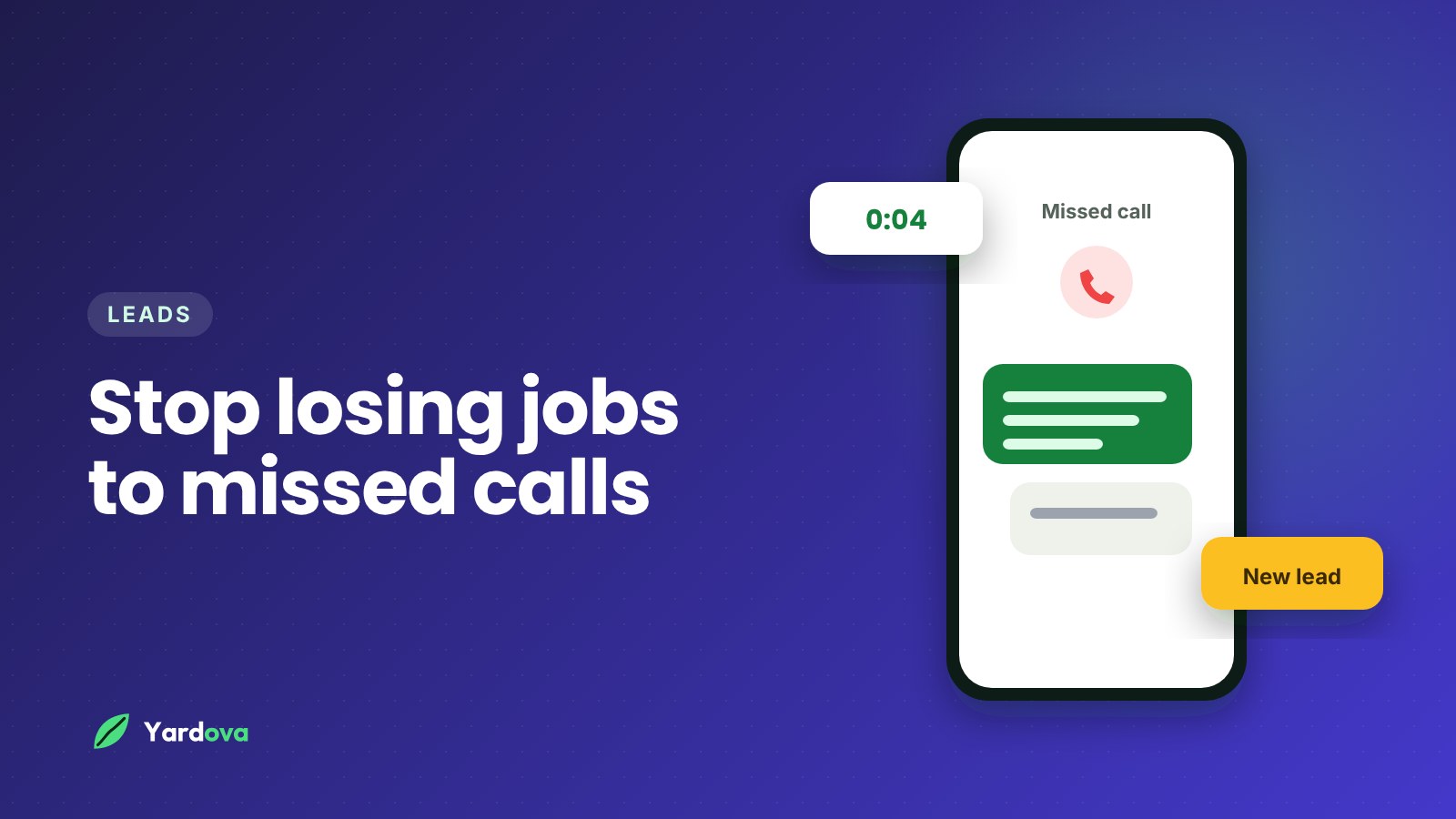
Missed calls are one of the most expensive problems in a small service business, and one of the easiest to ignore because you never see what they cost. When you're on a mower, up a ladder, under a sink or carrying a couch down three flights of stairs, you can't answer the phone. The person calling usually doesn't leave a voicemail. They hang up and call the next company on the list.
You never find out what that job was worth. It doesn't show up as a loss on any report. It just quietly doesn't happen.
This guide covers why missed calls happen, how to figure out what they cost you, how fast you really need to respond, and a step-by-step way to make sure every caller hears back quickly, even when you're on a job and can't touch your phone.
Why missed calls happen in service businesses
In an office business, someone sits by the phone all day. In a field service business, the people who could answer the phone are the same people doing the work. That's the whole problem in one sentence.
Here are the most common reasons calls go unanswered:
- You're physically on a job. Running equipment, wearing gloves, on a roof or in a crawl space. Answering isn't safe or possible.
- You're with another customer. Walking a property for a quote or explaining an invoice. Picking up would be rude to the person in front of you.
- You're driving. Between stops is when a lot of calls land, and you shouldn't be fumbling with a phone at 45 miles an hour.
- It's after hours. Many homeowners call in the evening or on weekends, when they finally have time to deal with the overgrown yard or the junk in the garage.
- Peak season overload. In spring for lawn care, summer for pool service, or the first heat wave for HVAC, calls stack up faster than one person can handle.
- The number is spread across phones. One line rings the owner's cell, another rings a crew lead, and nobody knows who is supposed to call back.
None of these are character flaws. They are built into how the work gets done. That's why the fix has to be a system, not a promise to "be better about answering."
What missed calls really cost you
The cost of missed calls is hard to see because nothing gets written down. Nobody sends you a note saying "I hired your competitor because you didn't pick up." So it helps to run some simple numbers for your own business.
A simple way to estimate the cost of missed calls
Here's a rough way to do the math. Use your own numbers, not these examples.
- Count how many calls you missed last week. Your phone's call log shows this.
- Estimate how many of those were new customers, not vendors or spam. Even a rough guess works.
- Estimate how many of those you would normally win if you talked to them.
- Multiply by your average job value.
For example, say you miss 10 calls a week and 4 of them are real new leads. If you normally win about half the people you actually talk to, that's 2 jobs a week. If your average job is $250, that's $500 a week, or about $26,000 over a year, walking out the door.
The lifetime value you don't see
That example only counts the first job. For recurring services, a single missed call can cost a lot more.
- A weekly lawn customer can be worth many visits a season, and often stays for years.
- A biweekly cleaning client books 26 times a year if they stay.
- A pool service customer might pay every month for as long as they own the house.
- A junk removal customer who has a good experience refers neighbors and calls again when they move.
When a recurring customer goes to someone else, you don't just lose one visit. You lose the whole relationship, plus the referrals that would have come from it.
The hidden costs nobody counts
Missed calls also cost you in ways that don't show up in revenue:
- Ad money wasted. If you paid for that click or that lead, a missed call means you paid for nothing.
- Reputation. People talk. "I called three times and nobody answered" is something neighbors say to each other.
- Your evening. Calling back ten people at 8 p.m. after a long day is exhausting, and half of them already hired someone.
Why callers don't leave voicemails
A lot of owners say, "If it's important, they'll leave a message." Most callers won't, and it helps to understand why.
The person calling is usually trying to solve a problem right now. They have a list of three or four companies from a search, a neighbor, or a lead site. If the first one doesn't answer, it's easier to tap the next number than to leave a message and wait.
Voicemail also feels like a dead end to many people. They don't know if anyone will listen to it today, tomorrow or next week. A lot of younger homeowners rarely check or leave voicemails at all. They'd much rather text.
So when you're looking at your call log, don't assume a call without a voicemail wasn't a real lead. Often it was a real lead who simply moved on.
How fast you need to respond to missed calls
When it comes to missed calls, speed matters more than almost anything else. The first company to have a real back-and-forth with the customer usually gets the job, as long as the price is reasonable.
Minutes, not hours
There's no magic number, but here's a practical way to think about it:
- Within a few minutes: You're still in the running. The customer may not have reached anyone else yet.
- Within an hour: You might still win it, but they've probably called someone else too.
- Later that day or the next day: Many will have already booked. You're calling to compete with a company that already scheduled them.
The goal isn't to drop your work and answer every call. That's not realistic and it's not safe. The goal is to make sure the caller hears something from you within a couple of minutes, so they stop dialing the next number.
Why a quick text works so well
A short text right after a missed call does three things at once:
- It tells the caller you're a real, active business, not a disconnected number.
- It gives them an easy way to keep the conversation going without waiting on hold or playing phone tag.
- It buys you time to finish the job you're on and respond properly.
Most people are happy to text back the details: their address, what they need, and when. By the time you're off the ladder, you often have everything you need to quote.
How to handle missed calls: a step-by-step process
Here's a simple process any small service business can set up in an afternoon. You don't need to do every step on day one, but the order matters.
- Check your call log for a week. Count total missed calls and how many were from unknown numbers. That's your baseline.
- Get one business number. Stop handing out multiple personal cell numbers. One number that everyone knows makes everything else easier.
- Set up an automatic missed call text back. When a call goes unanswered, the caller gets a text within a minute or so. This is the single biggest improvement for most businesses.
- Rewrite your voicemail greeting. Make it short, tell them they'll get a text, and ask for the key details.
- Add a quote request option. Give callers a link where they can describe the job and send photos, so you have what you need before you call back.
- Decide who handles callbacks and when. For example, the owner checks messages at lunch and at the end of each job. Write it down.
- Log every lead in one place. Every caller, texter and form submission goes into the same list, so nobody falls through the cracks.
- Follow up on anyone who goes quiet. A second text the next day wins back more jobs than you'd think.
- Review once a month. Look at how many missed calls became booked jobs and adjust.
Each of these steps is covered in more detail below.
Missed call text back: what to say
The text you send after a missed call should be short, friendly and clear about what happens next. It should sound like a person, not a robot, and it should make it easy to reply.
Missed call text template
Here's a simple template you can copy and adjust:
Hi, this is Mike with Green Edge Lawn Care. Sorry we missed your call, we're out on a job right now. What can we help you with? If you text your address and what you need, we'll get back to you with a quote today.
A few things that make this work:
- It uses a real name. People respond better to a person than a company.
- It explains why you didn't answer. "Out on a job" tells them you're busy because you're good, not because you're ignoring them.
- It asks a question. That invites a reply.
- It sets an expectation. "Today" gives them a reason to wait instead of calling around.
Variations for different trades
Adjust the wording to fit your work:
- Junk removal: "Text us a few photos of what needs to go and your address, and we'll send you a price range."
- Cleaning: "Let us know your address, the size of your home, and how often you'd like cleaning."
- Pest control: "What are you seeing, and where? A photo helps if you can grab one."
- Pool service: "Is this for weekly service or a one-time fix? Send your address and we'll get you a quote."
- HVAC or plumbing: "Is this an emergency? If you're without heat or water, reply URGENT and we'll call you back as soon as possible."
After-hours version
For calls that come in at night or on Sundays, be honest about timing:
Thanks for calling Summit Pressure Washing. We're closed for the evening, but we'll reach out first thing tomorrow morning. If you text your address and what you'd like cleaned, we can have a quote ready when we call.
This keeps the lead warm overnight and lets you start the next day with real information instead of a list of unknown numbers.
A note on texting rules
A text back to someone who just called your business is generally treated differently from a marketing blast, but rules for business texting do exist and change over time. Carriers may require business numbers to be registered, and sending promotions to people who haven't agreed to receive them can get you in trouble. Keep missed call texts focused on answering the person who called, and check the current rules where you operate before you send any marketing texts.
Set up your business voicemail greeting the right way
Even with a text back in place, some people will hit your voicemail. A good business voicemail greeting turns those moments into leads instead of hang-ups.
What a good greeting includes
- Your business name, so they know they reached the right place.
- A short reason you didn't pick up.
- What happens next, especially that they'll get a text.
- What details to leave, so you can call back ready to help.
Business voicemail greeting example
You've reached Clearview Window Cleaning. We're on a job right now, but you'll get a text from us in a minute. If you'd like, leave your name, address and what you need, and we'll get back to you today.
Keep it under 20 seconds. Long greetings make people hang up before the beep.
Turn voicemails into leads
A voicemail sitting in your phone isn't a lead yet. It becomes a lead when someone writes down the name, number, address and job details and puts it somewhere you'll see it. If you do this by hand, set a time each day to clear voicemails into your lead list. If your phone system can transcribe voicemails, use it. Reading is faster than listening.
Give callers other ways to reach you
Not everyone wants to call. If the only way to reach you is the phone, you'll always be stuck choosing between answering and working.
Add a quote request page
A simple quote request page on your website and Google Business Profile lets people tell you what they need on their own time. The best ones ask for:
- Name and phone number
- Service address
- What service they need
- A short description
- Photos, which are especially helpful for junk removal, tree work, painting and pressure washing
When a lead comes in this way, you have most of what you need to quote. If you want help writing that quote, see our guide on how to write a quote for a service business.
Make texting obvious
Put "Call or text" next to your number everywhere: your website, your truck, your yard signs, your Google profile. Many people would rather text than call, and a text can wait until you're off the job without anyone feeling ignored.
Lead sites and social messages
If you get leads from lead sites, Facebook or Google, those are just missed calls in a different form. A message that sits unanswered for six hours is the same as a call you never returned. Pull all of them into the same list and treat them with the same speed.
Answering service for small business: who should answer?
Once you've decided not to answer every call yourself, someone or something has to fill the gap. Here are the common options, with honest tradeoffs.
Option 1: The owner answers everything
This works when you're very small and slow. It falls apart as soon as you get busy, which is exactly when the calls matter most.
Option 2: Office help or a family member
A part-time office person can be great. The tradeoff is cost, training, and coverage. They still go home at 5, take lunch, and get sick.
Option 3: An answering service
A live answering service can pick up during the day and take messages. The tradeoffs: it costs money, the person answering doesn't know your pricing or schedule, and callers can usually tell they're talking to a message-taker. It's better than nothing, but it doesn't book the job.
Option 4: Automated text back and smart lead capture
An automatic missed call text back, combined with a quote request page and voicemail transcription, covers most of the gap for very little money. The caller hears from you right away, and you get the details in writing. You still respond personally, just a few minutes later and on your schedule.
Option 5: AI that drafts or sends replies
Some newer tools can draft replies to new leads based on your own business info, so you just review and send. This can save a lot of time, as long as the AI doesn't make up prices or promise appointment times you haven't confirmed. If you're curious how that works in practice, read our guide to AI for service businesses.
For most 1-15 person crews, a combination of options 4 and 5, plus the owner or office help for callbacks, gives the best coverage for the money.
Tips to turn missed calls into booked jobs
Getting back to people quickly is half the job. The other half is actually booking them. Here are practical tips that help.
Ask for what you need up front
Every back-and-forth costs time. Ask for the address, service needed and photos in your first reply so you can quote right away instead of scheduling a site visit for every job.
Quote fast, even if it's a range
If you can give a price range from photos, do it. "Based on your photos, this looks like about a half load, usually $X to $Y" keeps the customer engaged. For more on this, see our post on how to price junk removal.
Make it easy to say yes
Send the quote by text with a simple way to approve it. The fewer steps between "that sounds good" and "you're booked," the more jobs you'll win.
Follow up once or twice
A lot of people mean to reply and get distracted. A friendly follow-up the next day is not pushy. It's helpful.
Hi Sarah, just checking in on the quote for your backyard cleanup. We have an opening Thursday morning if that works. Want me to put you down?
Track where each lead came from
When you know which missed calls came from Google, your truck wrap or a referral, you know where your best customers find you. That helps you decide where to spend on marketing. Our guide on how to get more lawn care customers covers more of this.
Missed calls checklist
Use this checklist to see where your business stands. Every unchecked item is a place where leads can slip away.
- One business phone number that customers can call or text
- Automatic text sent to every missed call within a minute or two
- Separate after-hours text with honest timing
- Voicemail greeting under 20 seconds that mentions the text
- Voicemails turned into written leads every day
- Quote request page on your website and Google profile
- Photos accepted with quote requests
- "Call or text" shown everywhere your number appears
- All leads from calls, texts, forms and lead sites in one list
- A named person responsible for callbacks, with set times
- Follow-up message for leads who go quiet
- Monthly review of missed calls and how many became jobs
If you can check off most of these, you're ahead of most service businesses in your area.
Frequently asked questions
How many missed calls is normal for a small service business?
There's no single normal number, because it depends on your trade, season and how many people you have. Any missed call from a new customer that doesn't get a fast response is a problem worth fixing. Check your own call log for a week and use that as your baseline rather than comparing to someone else.
What is a missed call text back?
A missed call text back is an automatic text sent to someone who called your business and didn't reach anyone. It usually goes out within a minute or so and tells them you'll get back to them, while inviting them to text the details. It keeps the caller from moving on to the next company while you finish your current job.
Should I call back or text back after a missed call?
Do both, in that order: text right away, then call or keep texting when you're free. The quick text stops the caller from dialing your competitor, and the follow-up call or text is where you actually quote and book. Many customers will prefer to keep it to text, so let them choose.
Is it legal to send a text after a missed call?
Generally, replying to someone who just called your business is treated as a response rather than a marketing message, but texting rules do exist and change. Keep the text focused on the person's inquiry, don't add them to promotional lists without permission, and check the current rules and any carrier registration requirements where you operate.
Is an answering service worth it for a small business?
An answering service can be worth it if you get many calls that need a live person, such as emergency plumbing or HVAC. For many smaller crews, an automatic text back plus a quote request page covers most of the same need for less money. The best choice depends on how urgent your typical call is and your budget.
What should my business voicemail greeting say?
Your voicemail greeting should give your business name, say you're on a job, tell callers they'll get a text shortly, and ask for their name, address and what they need. Keep it under 20 seconds. Short, clear greetings get more messages and fewer hang-ups.
Wrap-up: stop letting missed calls cost you jobs
Missed calls aren't a sign you're doing something wrong. They're a sign you're busy doing the work. The fix is making sure every caller hears back in minutes, even when you can't pick up.
Start with the basics: one business number, a short voicemail, and an automatic text to every missed call. Add a quote request page with photos, keep all your leads in one list, and follow up with anyone who goes quiet.
If you'd like that set up without stitching tools together, Yardova sends an automatic text back to missed calls, turns voicemails into leads with the details filled in, and gives you a quote request page and business number in the same app. You can start a free Yardova account, compare plans and pricing, or book a demo to see it on your kind of work. Running a hauling crew? See how it fits on our junk removal software page.