How to Start a Lawn Care Business: A One-Mower Guide
How to start a lawn care business with one mower and a trailer: services, equipment budgets, licenses, pricing, first customers and a 30-day plan.
The Yardova team · 5 de noviembre de 2026 · 16 min de lectura
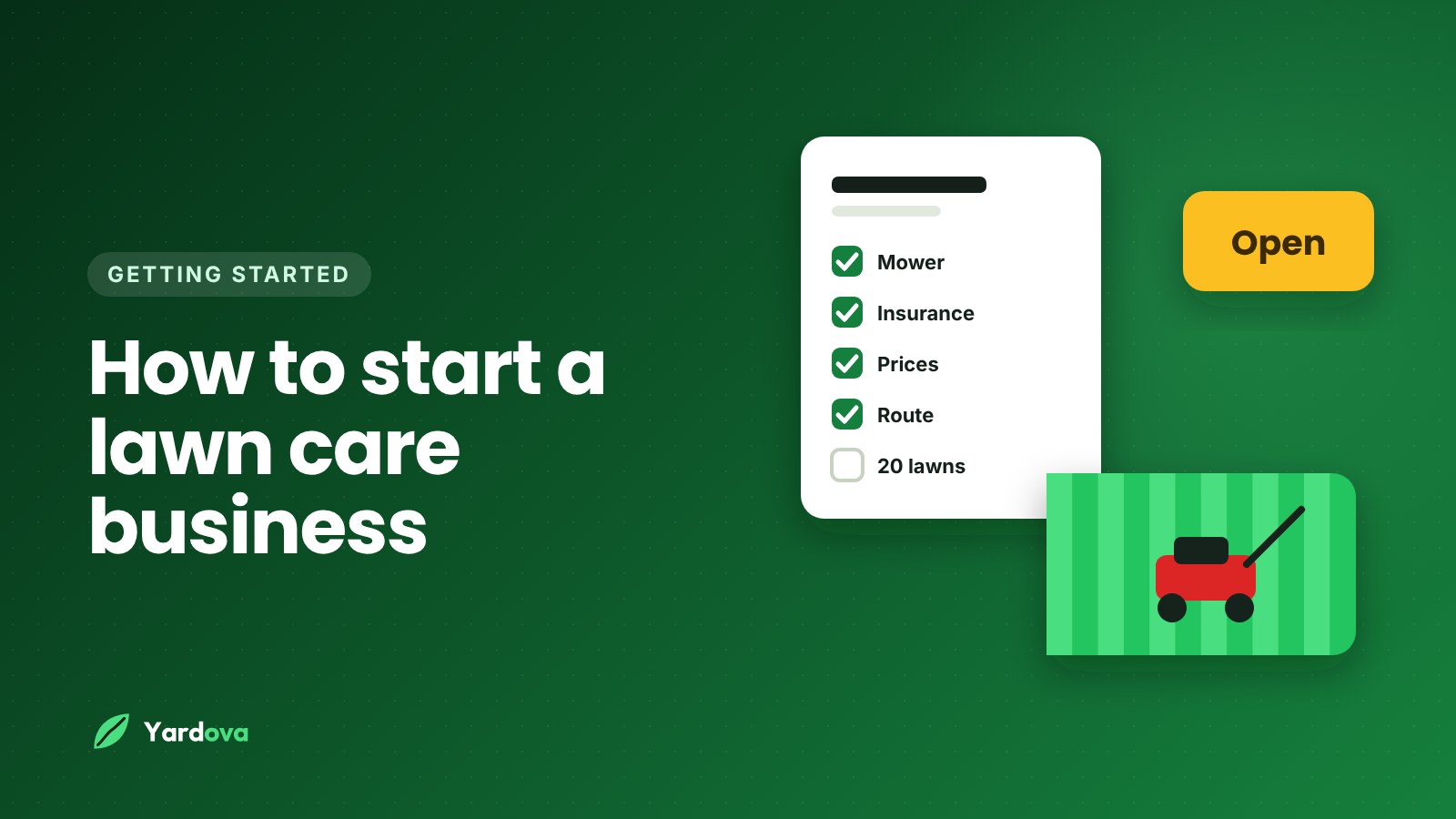
If you want to know how to start a lawn care business, the good news is that you can do it with one mower, a trailer, a truck and a phone that you actually answer. The harder part is everything around the mowing: pricing so you make money, building a route that doesn't burn your day in traffic, and getting paid without chasing anyone.
This guide walks through how to start a lawn care business step by step, with example startup budgets, a launch checklist, a first-30-days plan and mistakes to avoid.
How to start a lawn care business: the short version
Here is the whole process in one list. Each step gets its own section below.
- Pick a small set of services to start with, usually mowing, trimming, edging and blowing.
- Buy the equipment you need for those services, used where it makes sense.
- Register the business, check local license rules and get insured.
- Work out your cost per hour and set prices that cover it.
- Land your first 20 customers in a tight area.
- Build a route and a weekly and every-other-week schedule.
- Invoice after every visit and set up autopay.
- Ask for reviews, answer every lead fast and plan for the off-season.
Figuring out how to start a lawn care business doesn't take a business degree. It takes a plan, a few habits and the discipline to say no to work that doesn't fit.
Choose the lawn care services to offer first
When people research how to start a lawn care business, they often list fifteen services on day one. That spreads you thin and means buying equipment you'll barely use. Start narrow and add services once your route is full.
Start with the core: mowing, trimming, edging and blowing
Almost every residential lawn customer wants the same basic visit:
- Mowing at the right height for the grass type and season
- String trimming around fences, beds, trees and obstacles
- Edging along driveways, sidewalks and curbs
- Blowing clippings off hard surfaces so the property looks finished
This is your bread and butter. It repeats every week or two, it builds a route, and it's easy to price once you've done a few yards.
Add-ons to offer once you're running
After your first month, start offering simple extras to the customers you already have:
- Spring cleanups and bed cleanups
- Mulch installation
- Hedge and shrub trimming
- Leaf removal in the fall
- Aeration and overseeding
- Gutter cleaning (if you're comfortable on a ladder)
Add-ons raise what each stop is worth without adding drive time.
Services that need extra care before you offer them
Some services carry more risk or rules. Applying fertilizer, weed control or pesticides often requires a state applicator license, and the rules differ from state to state. Before you spray or spread anything for pay, check with the state agency that oversees pesticide applicators and with your insurance agent. Tree work, irrigation repair and hardscaping also bring different skills, tools and insurance questions, so hold off until the basics run smoothly.
Lawn care equipment and startup costs
Equipment is the biggest spending decision you'll face when working out how to start a lawn care business. Buy for the yards you'll actually mow, not the yards you hope to mow someday.
Lawn care equipment list for a one-mower start
Here is a practical starting list:
- Mower, sized for your typical yard (more on this below)
- 21-inch push mower for small yards, tight gates and backyards
- String trimmer
- Backpack or handheld blower
- Stick edger, or a trimmer you're comfortable edging with
- Trailer with a ramp gate, and straps or chains to secure the mower
- Truck rated to tow your loaded trailer
- Gas cans, spare blades, trimmer line, a blade sharpener or file, and basic hand tools
- Safety gear: eye and ear protection, gloves and sturdy boots
Residential vs commercial mowers
A residential mower is cheaper but built for one lawn a week, not thirty, and it wears out fast under daily use. A commercial mower costs more up front but is built to run all day, and parts are easier to find through dealers. Many owners start with a commercial-grade 21-inch push mower plus a used commercial zero-turn or stand-on mower. Match the deck width to your gates and lot sizes. A 60-inch deck is fast on open lots but useless if half your yards have 42-inch gates.
Buying used vs new lawn equipment
Buying used is a good way to keep startup costs down, as long as you're careful:
- Check the hour meter and ask for service records.
- Look for cracked decks, leaking hydraulics, worn belts and smoking engines.
- Start the engine cold and let it run for a while before you buy.
- Buy from a dealer when you can, since some offer a short warranty on used gear.
Handheld gear (trimmers, blowers, edgers) is cheap enough that buying new usually makes sense, since it takes the most abuse.
Lawn care business startup costs: example budgets
What it costs depends on what you already own. The two budgets below are made-up examples to show how the numbers add up. Your local prices will be different, so treat them as a template.
Example budget 1: lean start with a truck you already own
- Used utility trailer: $1,800
- Used 48-inch zero-turn mower: $2,500
- Used commercial 21-inch push mower: $600
- New trimmer, blower and stick edger: $1,200
- Gas cans, ramps, straps, blades, line and safety gear: $400
- Registration and insurance down payment: $1,000 (varies widely by location)
- Truck magnets, door hangers and a simple website: $400
- Starting cash for fuel and repairs: $800
Example total: about $8,700.
Example budget 2: commercial-grade setup
- New 6x12 utility trailer with racks: $3,300
- Used commercial 60-inch zero-turn mower: $7,000
- New commercial 21-inch push mower: $900
- Commercial trimmer, blower and edger: $1,600
- Registration and insurance down payment: $1,500
- Signage, website and printed materials: $800
- Starting cash for fuel and repairs: $1,500
Example total: about $16,600, plus a truck if you need one.
Monthly costs and a break-even example
Your monthly costs decide whether the business makes money. Typical ones are a truck or equipment payment, insurance, fuel, maintenance, phone and software, and marketing.
For example, say your fixed monthly costs come to $1,500 and each mowing stop leaves you $35 after fuel and wear. You'd need about 43 stops a month just to break even, or roughly 11 a week. Running this math before you launch is the most useful part of any lawn care business plan, because it tells you how many yards you need before you pay yourself.
How to start a lawn care business the right way: registration, licenses and insurance
This part of how to start a lawn care business is the least fun, but skipping it can cost you far more than it saves. Requirements vary by state, county and city, so the steps below are general. Check with your local licensing office, an insurance agent and an accountant before you take paid work.
Register the business
- Choose a name and check that nobody in your state is already using it.
- Pick a business structure. Many small operators form an LLC, but an accountant can tell you what fits.
- Get a tax ID if your structure or hiring plans call for one.
- Open a separate business bank account, run every job and expense through it, and keep every receipt.
Lawn care business license and permits
Some cities and counties require a general business license for anyone doing paid work. Some areas also have rules about commercial vehicles, trailers, noise hours or yard waste disposal. Call your local licensing office and ask what applies to lawn maintenance specifically. As covered above, fertilizer and pesticide work often needs a separate state applicator license, so ask about that before you offer it.
Insurance
A rock thrown from a mower deck can break a window. Common coverage lawn businesses look at includes general liability, commercial auto, equipment coverage and, once you hire, workers' compensation. What's required depends on your state, so ask an agent who works with contractors. Many homeowners, HOAs and property managers will ask for proof of insurance before you start, so have a certificate ready.
Pricing basics for a new lawn care business
Pricing is where new owners lose the most money. Going a few dollars under the cheapest price in town fills your schedule with yards that don't pay.
Start from your cost per hour
Add up what it costs to run the business for a year (insurance, truck, equipment payments, phone, software, marketing), add your direct costs per hour (fuel, wear, helper pay), then add the profit you want. Divide by the hours you expect to work, and you have a target hourly rate. Then estimate how long each yard takes, including drive time. Our guide on how much to charge for lawn mowing walks through this math with examples.
Price larger properties by size
For bigger lots, pricing by area keeps you consistent. If you plan to mow larger properties, read our breakdown of lawn mowing price per acre before you quote your first one.
Lawn mowing business tips for pricing
- Set a minimum charge per stop. Every stop costs you unloading, loading and drive time, no matter how small the yard.
- Charge more for the first cut on an overgrown yard. It takes longer and is harder on equipment.
- Price every-other-week mowing higher per visit. The grass is taller and takes longer.
- Raise prices once a year. Small, regular increases are easier for customers than one big jump.
- Send a written quote. Our guide on how to write a quote for a service business covers what to include.
How to get lawn care customers: your first 20
You don't need hundreds of customers to have a real business. Twenty good recurring yards in a tight area is enough to cover costs and start building. Here's how to get there.
Start with people you know, then their neighbors
Tell friends, family and neighbors you're open for business and ask each one to mention you to two people. Your first five yards often come from here.
Set up your Google Business Profile
Claim your profile, list your service area by town or zip code and add photos of your work. The businesses on the map get the "near me" calls.
Door hangers around every yard you mow
Every yard you finish is an ad for the houses next to it. Leave door hangers on five to ten neighboring houses on the same day. This builds density, which matters more than raw customer count. For more ideas, see our full guide on how to get more lawn care customers.
Answer calls and quote requests fast
Homeowners often call a few companies and hire the first one who responds. If you're on a mower all day, try this:
- Check messages at set times, such as mid-morning, lunch and end of day.
- Set up an automatic text reply for missed calls so callers know you'll get back to them.
- Use a short quote request form on your website and Google profile so people can send their address and what they need.
Missed calls are expensive for a small crew. Our post on what missed calls cost service businesses explains why. Here is a simple text you can send when you can't pick up:
Hi, this is Mike with Green Line Lawn Care. Sorry I missed your call, I'm on a mower right now. Can you text me your address and what you need (mowing, cleanup, etc.)? I'll get you a price today.
Get reviews from day one
Ask every happy customer for a Google review right after a visit they're pleased with, and send the link by text. Ten honest reviews make a new business look far more trustworthy. Our guide on how to get more Google reviews covers how to ask and what to avoid. Check Google's current review rules before offering anything in exchange for a review.
Lawn care route planning and weekly vs biweekly schedules
Route density is the part of learning how to start a lawn care business that new owners often skip. Once you have customers, the way you schedule them decides how much you earn per hour, because drive time is unpaid time.
Build a tight route
- Group customers by area. Try to mow the same neighborhood on the same day.
- Say no to far-off yards, or charge a travel fee, until you have enough work nearby.
- Assign each area a day. For example, Monday on the north side, Tuesday on the east side.
- Order stops to cut backtracking. Plan the day so you finish near where tomorrow starts or near home.
Weekly vs biweekly mowing
Weekly mowing keeps lawns looking their best during peak growth and is easier on your equipment. Biweekly (every other week) mowing is cheaper for the customer per month but means taller grass, more clippings and longer visits.
A few practical rules:
- Charge more per visit for every-other-week service.
- Balance biweekly customers so you have roughly equal "A week" and "B week" loads.
- In peak spring growth, some owners require weekly service and offer biweekly later in the season.
- Put the schedule in writing so customers know which week they're on.
Our guide to crew scheduling for service businesses has more on repeating jobs and rain delays.
Invoicing, autopay and getting paid
Mowing is low-dollar, high-volume work. If ten of your 60 customers pay late, your evenings go to chasing money.
Invoice after every visit or monthly
Pick one approach and stick to it:
- Per visit: send an invoice when the yard is done.
- Monthly: bill once a month for all visits, with each visit date listed.
Whichever you choose, put the service date, address, what you did and the amount on the invoice. Our landscaping invoice guide shows what to include and how to word it.
Set up autopay
Autopay is the best thing you can do for cash flow. When a customer saves a card, you can charge it after each visit or on a set monthly date. No checks under doormats, no reminders, no awkward conversations.
Offer it to every new customer at signup. Something simple works:
Thanks for choosing us! Most of our customers save a card so they're charged automatically after each mow. You'll still get a receipt every time. Want me to set that up for you?
Follow up on unpaid invoices
Set a routine: a friendly reminder a few days after the due date, a second one a week later, then a phone call. For more ways to shorten the wait, read our guide on how to get paid faster.
Seasonal planning: spring, fall and winter work
Lawn care is seasonal in most of the country, so knowing how to start a lawn care business includes knowing how to keep it going when the grass stops growing.
Spring cleanups
Spring is your biggest sales window, because homeowners are picking a mowing company for the season. Offer cleanups (debris removal, bed edging, first cut, mulch) and use each one to sign a recurring mowing plan.
Fall leaf removal
Fall leaf removal is a strong add-on for mowing companies. Offer it to your mowing customers first, and price it carefully, since leaf jobs vary a lot by tree cover. Our guide on how much to charge for leaf removal breaks it down.
Winter: snow removal or off-season work
In colder areas, snow removal can keep your truck busy all winter, but it brings new equipment, insurance questions and early mornings. See how much to charge for snow removal if you're considering it. Otherwise, use winter to service equipment, update prices and send renewal notices for next season.
Hiring a lawn care helper
At some point you'll have more yards than one person can handle. That's when a helper makes sense, but hiring too early can eat your profit.
Signs you're ready
- Your route is full most weeks and you're turning work away.
- You're working long days and still falling behind after rain.
- Your recurring revenue can cover a helper's pay through slow weeks.
How to hire your first helper
- Write down exactly what the helper will do (trimming, edging, blowing, running the push mower).
- Check with an accountant on the difference between an employee and a contractor, and what payroll and taxes involve in your state.
- Talk to your insurance agent about coverage, including workers' compensation.
- Hire for reliability first. You can teach someone to edge, but you can't teach them to show up.
- Train them on safety, then on your standards for how a finished yard should look.
- Track hours with a time clock from day one so payroll is accurate.
Lawn care business checklist and your first 30 days
This is the practical side of how to start a lawn care business: a checklist to get ready, then a plan for the first month.
Pre-launch lawn care business checklist
- Business name chosen and registered
- Business bank account opened
- Local license requirements checked
- Insurance in place with a certificate ready
- Mower, push mower, trimmer, blower and edger tested and sharpened
- Trailer secured, lights working, straps in place
- Price list and minimum charge set
- Google Business Profile claimed and filled in
- Simple website or quote request page live
- Door hangers and truck magnets printed
- Invoicing and card payments set up
- Business phone with a missed-call text reply
Your first 30 days: a step-by-step plan
- Days 1-3: Finish registration, insurance and banking. Set your prices.
- Days 4-5: Claim your Google profile, set up your quote request page and test your phone setup.
- Days 6-7: Tell friends, family and neighbors. Post in local community groups where allowed.
- Days 8-14: Mow your first yards. Leave door hangers on neighboring houses after every job.
- Days 15-18: Ask your first happy customers for Google reviews.
- Days 19-21: Group customers by area and set route days.
- Days 22-25: Offer autopay to every customer who hasn't saved a card.
- Days 26-28: Offer one add-on, such as hedge trimming or mulch, to your current customers.
- Days 29-30: Review your numbers: revenue, hours, drive time and profit per stop. Adjust prices or your service area.
Mistakes to avoid
- Underpricing to win work. You'll be busy and broke.
- Taking yards everywhere. Drive time kills your hourly rate.
- Skipping insurance. One accident can wipe out a season.
- Buying too much equipment too soon. Start with what you need for core services.
- Not answering the phone. The next company will.
- Ignoring the off-season. Plan winter income or savings before fall ends.
Frequently asked questions
How much does it cost to start a lawn care business?
It depends mostly on whether you already own a truck. In the example budgets above, a lean start with a truck you own came to about $8,700, and a commercial-grade setup came to about $16,600 before a truck. Your local equipment and insurance prices will differ, so build your own budget from real quotes.
Do I need a license to start a lawn care business?
You may need a general business license, depending on your city, county and state. Applying fertilizer or pesticides often requires a separate state applicator license. Check with your local licensing office and your state's pesticide regulator before taking paid work.
Is a lawn care business profitable?
A lawn care business can be profitable if you price from your real costs, keep your route tight and get paid on time. Most profit problems come from underpricing, long drive times between yards and unpaid invoices. Run your break-even math before you launch so you know how many stops you need each week.
Should I buy a residential or commercial mower to start?
A commercial mower is usually the better choice once you're mowing more than a handful of yards a week. Residential mowers cost less but wear out faster under daily use. Many owners start with a used commercial mower and a commercial-grade push mower to keep costs down.
How do I get my first lawn care customers?
Start with friends, family and neighbors, then claim your Google Business Profile and leave door hangers around every yard you mow. Answer calls and quote requests fast, and ask happy customers for reviews. Focus on one or two neighborhoods so your route stays tight.
Wrap-up: how to start a lawn care business that lasts
Learning how to start a lawn care business comes down to a few basics done well. Start with core services, buy the equipment you need, get registered and insured, and price from your real costs. Then build a tight route, answer leads fast, set up autopay and plan for every season.
When you're ready to get organized, Yardova puts your leads, quotes, repeating mowing jobs, today's stops in driving order, invoices with autopay and automatic review requests in one app built for small crews. See how it works on our lawn care software page, compare plans and pricing or book a demo. You can also start a free Yardova account with no card needed and run your first 50 customers through it.