How Much to Charge for Lawn Mowing: A Pricing Guide
How much to charge for lawn mowing: figure your real costs, price by lot size and time, set minimums, and raise prices without losing good customers.
The Yardova team · 28 de outubro de 2026 · 16 min de leitura
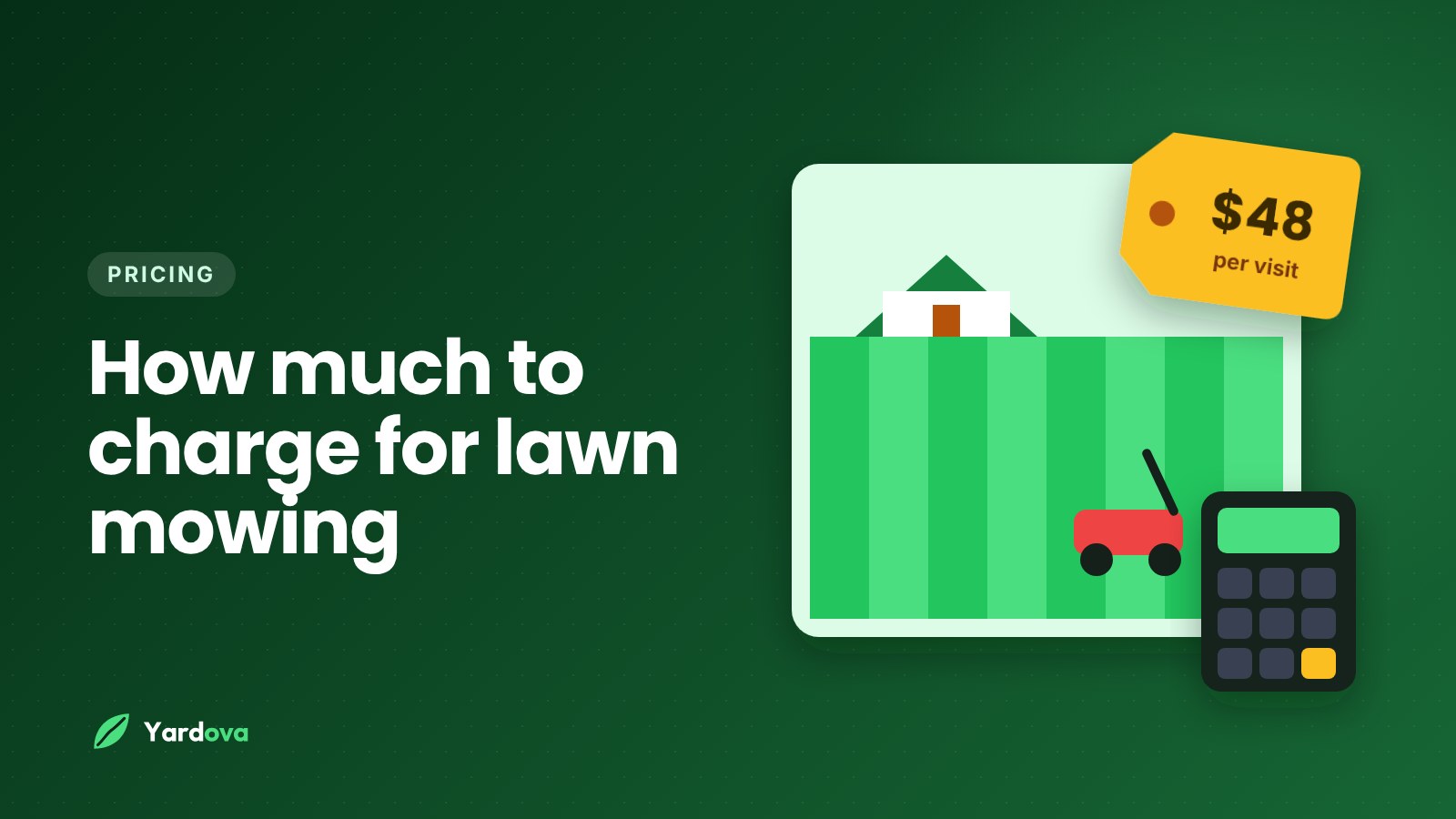
Figuring out how much to charge for lawn mowing is the single decision that decides whether your mowing route pays your bills or just keeps you busy. Charge too little and you work six long days for a thin paycheck. Charge too much without a reason and the phone goes quiet. The good news is that pricing mowing is not guesswork once you know your numbers.
This guide walks through the full process: what your time actually costs, the common ways to price a yard, minimums, add-ons, contracts, and how to raise prices on existing customers without losing the good ones. Every number below is an example to show the math. Plug in your own costs and your own market.
Why "what everyone else charges" is the wrong starting point
Most new mowing businesses pick a price by checking a few competitors or asking in a Facebook group. That tells you what the market will tolerate, which is useful later. It does not tell you whether that price works for your truck, your mower, your drive times and your overhead.
Two operators can charge the same $50 for the same yard. One makes good money because his route is tight and his equipment is paid off. The other loses money because he drives 25 minutes between stops and still has a mower payment. Same price, very different business.
So start with your costs, then check the market. If your cost-based price lands far above what the area pays, that is a signal to fix your route, your equipment or your target customers, not just to cut the price.
Step one for how much to charge for lawn mowing: know your cost per hour
Before you can price a single yard, you need to know what one hour of your crew in the field costs you. This is the foundation of every quote.
Add up your yearly overhead
Overhead is everything you pay whether you mow one yard or fifty. For example:
- Truck payment, insurance, registration and maintenance
- Trailer and mower payments, or a yearly amount set aside to replace them
- Business insurance and licensing
- Phone, software, marketing and your website
- Accounting and bank fees
- Storage or shop rent
Suppose that adds up to $18,000 for the year. If you mow about 30 weeks a year and work about 40 billable hours a week, that is 1,200 billable hours. Your overhead is $15 per billable hour.
Add your direct cost per hour
Direct costs go up and down with the work you do:
- Fuel for the truck and equipment
- Blades, string, oil, filters and other wear parts
- Labor, including payroll taxes and workers' comp if you have employees
- Dump fees if you haul clippings or debris
For example, fuel and parts might come to $8 an hour. A helper paid $18 an hour costs closer to $21 to $23 once you add payroll costs. If you work alone, pay yourself a real wage here too, such as $25 an hour. Your time is not free just because you own the business.
Add the profit you want
Profit is not the same as your wage. It is what the business keeps to grow, replace equipment early, survive a rainy month and pay you back for the risk. Many owners aim for somewhere around 15 to 25 percent on top of costs.
Here is the example math for a solo operator:
- Overhead: $15 per hour
- Fuel and parts: $8 per hour
- Owner wage: $25 per hour
- Total cost: $48 per hour
- Add 20 percent profit: about $58 per hour
That $58 is your target billable rate. Every price you set should be checked against it.
The four common ways to price lawn mowing
Once you know your hourly target, you need a way to turn it into a price per yard. There are four common approaches, and most experienced operators blend them.
Price per visit based on time
This is the most direct method. Estimate how long the yard takes, including mowing, trimming, edging and blowing, then multiply by your rate.
For example, a yard that takes 40 minutes on site at $58 an hour comes to about $39. Then add drive time if the stop is out of the way (more on that below).
Time-based pricing is accurate, but only if your time estimates are accurate. Time your first few dozen yards with a stopwatch on your phone. You will be surprised how much the trimming and blowing add.
Lawn mowing price per square foot or per acre
Some businesses price by area: a set amount per 1,000 square feet or a lawn mowing price per acre for big properties. This is fast to quote from an online map before you ever visit.
The weakness is that area ignores obstacles. A flat, open half-acre and a half-acre full of beds, trees, swing sets and slopes take very different amounts of time. If you price by area, build in a difficulty adjustment.
Flat pricing tiers by lot size
Many residential mowing businesses use simple tiers, for example:
- Small lot (most city lots): one price
- Standard lot (typical suburban yard): a higher price
- Large lot (up to about half an acre): higher again
- Anything bigger: quoted individually
Tiers are easy for customers to understand and easy for you to quote fast. Set each tier price using your hourly rate and your average time for that size of yard, not by picking round numbers that feel right.
Monthly or seasonal pricing
Instead of charging per visit, you charge a flat monthly amount that covers the expected number of visits. For example, a weekly customer at $45 a visit might be about four and a third visits a month on average, so roughly $195 a month.
Monthly pricing smooths out your cash flow and makes customers less likely to skip weeks. It works best combined with automatic payments so you are not chasing invoices. If you want to tighten up how you collect, see our guide on how to get paid faster as a service business.
What changes the price of a mowing job
Two yards with the same square footage can deserve very different prices. When you look at a property, check for these factors and adjust.
Obstacles and detail work
Every bed, tree ring, fence line, play set and garden adds trimming time. A yard with string-trimming along 300 feet of fence is a different job from an open rectangle. Count the obstacles and add time for each.
Slopes and terrain
Hills slow you down and can force you to switch from a rider to a push mower. Steep banks may need a string trimmer or special equipment. Price the extra time and the extra wear and risk.
Grass condition and growth
A thick, fast-growing lawn in peak season takes longer than a thin one in late summer. Overgrown first cuts often take two or three times as long as a normal visit. Charge a one-time first-cut or cleanup fee instead of absorbing that time.
Access and gates
Narrow gates that only fit a 21-inch mower, steps between the front and back yard, or parking far from the property all add time. Ask about gates when you quote and note the widths.
Clippings and haul-away
Bagging and hauling clippings takes time and may come with dump fees. Mulching is faster. If a customer wants clippings removed, price it as an add-on.
Drive time and route density
This is the factor most new owners ignore. If a yard is 20 minutes away from your other stops, those 20 minutes cost you the same as 20 minutes of mowing. Either charge more for out-of-the-way yards or politely decline them.
The fix that pays the most is route density: more customers on the same streets. A tight route can let you charge competitive prices and still earn more per hour than a spread-out route charging more. Our post on crew scheduling for service businesses covers how to build tighter routes.
Lawn mowing price examples you can adapt
Here are worked examples using the $58-per-hour target from earlier. These are not market prices. They show how to apply the method.
Example 1: small city lot
- Mow, trim and blow: 25 minutes
- Close to other stops: no extra drive time
- 25 minutes at $58 an hour is about $24
That is below what many operators would accept for a stop. This is where a minimum charge comes in, which we cover next. You might set this yard at your minimum instead.
Example 2: standard suburban yard
- Mow, trim, edge and blow: 45 minutes
- 5 minutes of extra drive time
- 50 minutes at $58 an hour is about $48
A price of $48 to $50 a visit for weekly service would hit your target.
Example 3: large lot with obstacles
- Rider mowing: 40 minutes
- Trimming around 12 trees and long fence line: 25 minutes
- Blowing: 10 minutes
- 75 minutes at $58 an hour is about $73
If the customer wants bagging, add the extra time plus any dump fee.
Example 4: first cut on an overgrown yard
- Normal visit would be 45 minutes
- Overgrown first cut takes about 2 hours, plus extra blade wear
- 2 hours at $58 an hour is about $116 for the first cut, then the normal weekly price after that
Spell this out in the quote so there are no surprises on the first invoice.
Set a minimum charge for every mowing stop
A minimum charge is the least you will accept for any visit, no matter how small the yard. Every stop has fixed costs: unloading, loading, a few minutes of driving, and the risk of a locked gate or a dog in the yard.
To set yours, figure out the time a stop takes before you even start mowing, such as 10 to 15 minutes of travel, unloading and loading. Add the shortest realistic mowing time. Multiply by your hourly rate.
In the example above, a minimum around $40 to $45 per visit would protect you from tiny yards that look profitable on paper but are not. Many owners find that raising their minimum is the single fastest way to raise their average hourly earnings.
Pricing add-ons and upsells
Mowing gets you in the door. Add-on services, priced well, are often where the better margins are. Common ones include:
- Edging sidewalks and driveways (if not already included)
- Hedge and shrub trimming
- Spring and fall cleanups
- Leaf removal
- Mulch installation
- Aeration and overseeding
- Weed control in beds
- Gutter cleaning for existing customers
Price each add-on with the same method: time plus materials plus profit. For materials like mulch, mark up what you pay. Customers expect you to make something on the material, and you are paying for the pickup, the loading and the risk of overbuying.
The easiest time to sell an add-on is on a visit. If your crew notices overgrown hedges, a quick text with a price often gets a yes the same day. Our guide on how to write a quote for a service business has a simple template for these quick quotes.
Lawn mowing contract price and seasonal agreements
A seasonal agreement is a simple written agreement for a set number of visits at a set price. It helps you plan your route and helps customers know what to expect.
What to put in a mowing agreement
Keep it short and clear:
- Visit frequency (weekly or every other week) and the season start and end
- What every visit includes (mow, trim, edge, blow)
- Price per visit or per month, and how payment works
- What happens with rain delays
- How to skip a week or cancel, and how much notice you need
- What costs extra (first cut, cleanups, bagging)
Weekly versus every-other-week pricing
Every-other-week service sounds like half the work, but it often is not. The grass is taller, the clippings are heavier and the visit takes longer. Many operators charge every-other-week customers more per visit than weekly customers, often around 15 to 30 percent more. It also makes weekly service the better deal, which nudges people toward it and fills your route.
Prepay discounts
Some customers like paying for the whole season up front. A small discount, such as one free visit or a few percent off, can be worth it for the cash flow and the guaranteed season. Only offer it if you are comfortable delivering every visit.
How to raise lawn care prices without losing good customers
Costs go up every year. Fuel, equipment, insurance and wages rise, and if your prices stay flat, your pay goes down. Raising prices is part of running the business, not a betrayal of your customers.
When to raise prices
- Before the season starts, so customers can plan
- When your costs have clearly gone up
- When your schedule is full and you are turning away work
- On any customer who is well below your current prices
How much to raise them
A modest yearly increase is easier for customers to accept than a big jump every few years. For customers who are far under your current rate, it can make sense to raise them in two steps over two seasons.
How to tell customers
Send a short, friendly note a few weeks before the change. No long apologies. For example:
Hi Maria, thanks for another great season with us. Starting April 1, weekly mowing for your yard will be $52 per visit. That covers higher fuel and equipment costs so we can keep the same crew and the same quality. If you have any questions, just reply to this text. We look forward to seeing you this spring.
Most good customers will accept a fair increase without a second thought. The few who leave over a few dollars are usually the ones who were costing you the most in time and hassle.
Quoting checklist: how to price lawn care jobs fast and accurately
Use this checklist every time you quote a mowing customer:
- Check the lot size on an online map before the visit
- Ask about gates, dogs and where to park
- Count beds, trees, fences and other trimming areas
- Note slopes and anything that needs a push mower
- Ask whether they want clippings bagged or mulched
- Check how far the property is from your nearest existing stop
- Estimate on-site time and drive time
- Multiply by your hourly target and compare with your tiers
- Apply your minimum charge
- Add a first-cut fee if the lawn is overgrown
- List what's included and what costs extra
- Send the quote the same day
Speed matters. The company that sends a clear price first often wins the job, especially for customers who found you online. If you are missing calls while you are on the mower, you are losing quotes before you ever see the yard. Our post on how missed calls cost service businesses jobs covers simple fixes.
Mistakes that keep mowing prices too low
These are the most common reasons mowing businesses work hard and still struggle:
- Not counting your own time as a cost. If you only cover fuel and equipment, your "profit" is really your wage, and you have no business profit at all.
- Ignoring drive time. Twenty minutes between stops adds up to hours every week.
- No minimum charge. Small yards at small prices fill your day without filling your bank account.
- Pricing every-other-week the same as weekly. You do more work per visit for the same money.
- Absorbing first cuts and cleanups. Overgrown yards should be priced as the extra work they are.
- Never raising prices. Every year you hold steady, rising costs quietly cut your pay.
- Competing on price alone. The cheapest company attracts the customers who leave first. Compete on showing up when you said you would, communicating well and doing clean work.
Showing up reliably and communicating well also earns you reviews, which lets you charge more over time. See how to get more Google reviews for a simple system.
Tools that make lawn care pricing easier
You can price mowing with a notebook and a calculator, but a few tools save real time once you have more than a handful of customers:
- A saved price list so every crew member quotes the same prices for the same services
- Online maps to measure lots before you visit
- Quotes customers can approve from their phone so you are not waiting on callbacks
- Repeating jobs for weekly and every-other-week customers so your route builds itself
- Automatic payments so monthly and per-visit customers pay without reminders
- Reports by service so you can see which services and which areas actually make money
If you are comparing options, our guide to a CRM for small service businesses explains what matters for a mowing business. Yardova's lawn care software handles the pieces above in one place: saved price lists for fast quotes, quotes customers approve in one tap, weekly and every-other-week repeating jobs, and invoices with card payments and autopay. You can start a free Yardova account or compare plans and pricing.
Frequently asked questions
How much should I charge to mow a lawn?
Charge your hourly cost plus profit, multiplied by the time the yard takes, with a minimum charge per visit. Work out what one hour costs you (overhead, fuel, parts and your wage), add a profit margin, and then time the yard including trimming and blowing. Prices vary a lot by region, so check your result against what local companies charge.
Should I charge by the hour or by the yard for lawn mowing?
Most customers prefer a set price per visit, so quote per yard but calculate it from your hourly rate. Charging the customer by the hour makes them nervous about how long you take. Calculating your per-visit price from your hourly target keeps you profitable while giving customers a simple number.
How do I figure out my lawn mowing price per acre?
Time how long an acre takes with your equipment, including trimming, and multiply by your hourly rate. Then adjust up for obstacles, slopes and bagging. A flat, open acre and an acre with trees and beds can take very different amounts of time, so don't use one per-acre number for every property.
How much more should I charge for every-other-week mowing?
Many operators charge every-other-week customers somewhere around 15 to 30 percent more per visit than weekly customers. The grass is taller and heavier, so each visit takes longer. Higher biweekly pricing also makes weekly service the better deal, which helps fill your route.
How much should I charge for the first cut on an overgrown yard?
Charge for the actual time it takes, usually as a one-time fee on top of or instead of the first regular visit. An overgrown first cut can take two or three times as long as a normal visit and wears blades faster. Put the first-cut fee in writing in the quote so the first invoice is not a surprise.
How often should I raise my lawn care prices?
Review your prices every year before the season starts. Small yearly increases are easier for customers to accept than large, rare jumps. Give customers a few weeks' notice with a short, friendly message explaining the new price.
What is a good minimum charge for lawn mowing?
A good minimum covers the fixed time of every stop plus the shortest realistic mowing time, at your hourly rate. Add up travel, unloading and loading time, add the quickest yard you would accept, and multiply by your target rate. Raising a too-low minimum is one of the fastest ways to raise your average earnings per hour.
Wrap-up: how much to charge for lawn mowing, made simple
Knowing how much to charge for lawn mowing comes down to a few steps you can repeat on every yard:
- Know your real cost per hour, including your own wage and your overhead
- Add a profit margin on top
- Estimate the time for each yard, including trimming, blowing and drive time
- Use tiers or per-visit prices built from that hourly target
- Set a minimum charge and a first-cut fee
- Charge more for every-other-week service and for add-ons
- Raise prices a little every year, with clear notice
Do this consistently and your mowing route stops being a busy schedule and starts being a business that pays you properly. If you want help building quotes and routes, see more ideas on how to get more lawn care customers, start a free Yardova account, or book a demo and we'll walk through it with you.