How Much to Charge for Stump Grinding: A Pricing Guide
How much to charge for stump grinding: per-inch, per-stump and hourly pricing, cost per machine hour, add-ons, examples and a quote checklist.
The Yardova team · 4 de novembro de 2026 · 16 min de leitura
Figuring out how much to charge for stump grinding looks simple until you are standing in a backyard staring at a 34-inch oak stump with roots under the patio and a 36-inch gate between you and the trailer. Price it too low and you spend the afternoon working for fuel money. Price it with no logic and you lose the easy jobs to the next company.
This guide covers the common pricing methods, how to measure, how to find your cost per machine hour, what makes a stump harder, how to handle add-ons and multiple stumps, and how to send a quote that gets approved.
Every dollar figure here is a labeled example to show the math. Prices vary widely by region, equipment and competition, so plug in your own costs and check your own market.
How much to charge for stump grinding: the four common pricing methods
Most stump grinding businesses use one of four methods, or a mix. The best one is the method you can quote fast, explain in one sentence, and that covers your costs on hard jobs as well as easy ones.
Stump grinding price per inch
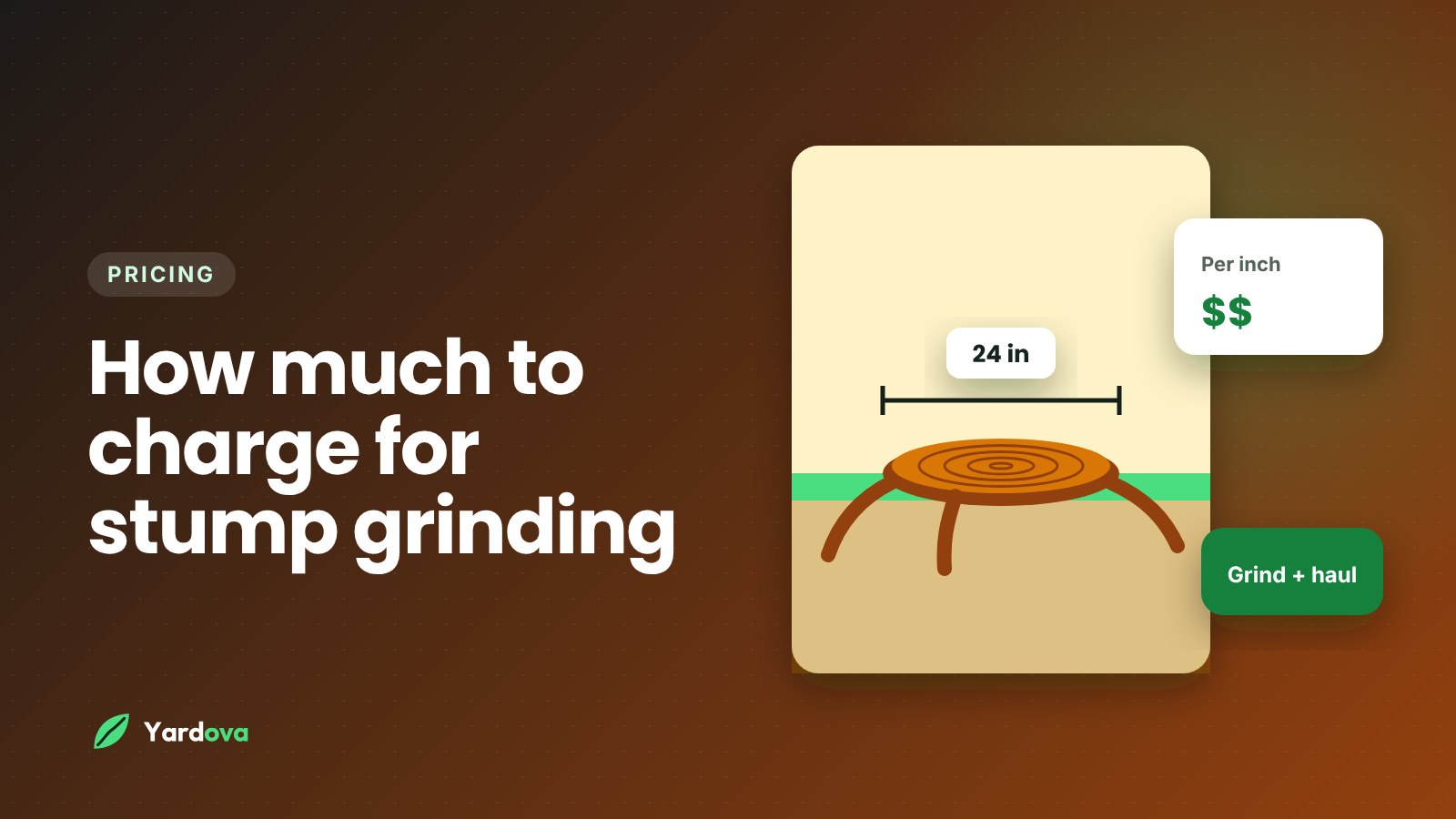
Per-inch pricing is the most common approach. Measure the stump across, multiply by your rate, done. For example, a 20-inch stump at an example rate of $4 per inch is $80.
Why it works:
- Customers understand it instantly
- It scales with stump size, which roughly tracks grinding time
- Anyone on your team can quote it the same way
- It is easy to load into a price list or a tree service estimate app
The weakness is that inches are not the only thing that drives time. A 20-inch soft pine and a 20-inch oak with big surface roots are different jobs. That is why per-inch pricing works best with a minimum charge and a short list of adjustments.
Price per stump
Some companies charge a flat price per stump by size band, such as under 12 inches, 12 to 24 inches, and over 24 inches. Flat pricing is easy to say over the phone. The risk is that a stump at the top of a band gets the same price as one at the bottom, so keep bands narrow.
Hourly pricing
Hourly pricing charges for machine and operator time on site. It fits big, unpredictable jobs: lot clearing, dozens of stumps, rocky ground or heavy root work. Homeowners dislike open-ended pricing, so give an estimated range and say what would push it higher.
Stump grinding minimum charge
A minimum charge sits on top of whichever method you use. It covers the cost of showing up: loading, driving, setting up, cleaning up and driving back.
Without a minimum, a single 8-inch stump at a per-inch rate looks like a $32 job. That does not cover the truck roll. Your minimum is what you need to earn just to start the engine at someone's house.
How to measure a stump for grinding
Before you settle how much to charge for stump grinding on a job, measure it the same way every time. If one person measures at the top of the cut and another at the ground, the same stump gets two prices.
Where to measure
The usual practice is to measure the widest point straight across the stump at ground level. If the stump is oval, measure the widest direction, or average wide and narrow, and write down which rule you use. When customers ask, a simple answer helps: "We measure the widest point at ground level."
Root flare counts
Older hardwoods often flare out wide at the base. The flare is wood you have to grind, so it counts. A stump that measures 18 inches at the cut might be 26 inches at the ground.
If another company cut the tree, the stump may be high. More height means more wood to chew through before you reach grade, so note height as well as width.
Measure surface roots separately
Roots running along the surface are not part of the diameter. Note how many, how thick, and how far from the stump the customer wants them removed. That becomes its own line item. A phone photo with a tape laid across the stump settles most questions later.
Know your stump grinding cost per hour first
Every pricing method sits on one number: what one hour of your grinder and operator on a job costs you. Without it, any per-inch rate is a guess, and you cannot really know how much to charge for stump grinding.
What goes into your cost per machine hour
- Machine payment or rental: your monthly loan or lease payment, or the daily rental rate
- Teeth and pockets: carbide teeth wear fast in sandy or rocky soil, so track hours per set
- Fuel: grinder fuel plus truck fuel
- Trailer and truck: payment, tires, maintenance and registration
- Insurance: general liability and, with employees, workers' comp; requirements vary by state, so check with your insurance agent
- Maintenance: belts, bearings, filters, grease and repairs
- Labor: operator and helper wages with payroll costs, including your own pay
- Overhead: phone, software, marketing, accounting and anything you pay whether you grind or not
A worked example with example numbers
Here is a one-grinder example. These are made-up numbers to show the method, not industry figures. Assume the grinder works about 60 hours a month on customer stumps, counting on-site time only.
- Grinder payment: $900 per month divided by 60 hours = $15 per hour
- Teeth and pockets: example $8 per hour
- Fuel for grinder and truck: example $10 per hour
- Truck and trailer costs: example $12 per hour
- Insurance: $480 per month divided by 60 hours = $8 per hour
- Maintenance and repairs: example $5 per hour
- Operator and helper labor with payroll costs: example $50 per hour
- Overhead: $600 per month divided by 60 hours = $10 per hour
- Total cost: $118 per on-site hour
- Add 25 percent profit: about $148, rounded to $150 per on-site hour
In this example, $150 is your target for every hour the grinder works at a customer's property. Drive time and setup get covered by your minimum and your rates.
If you rent the grinder
A rental is a fixed cost for the day no matter how many stumps you grind. For example, a $350 day rental with two small stumps booked eats your profit. Owners who rent usually batch stump jobs into one day or set a higher minimum.
Turning your hourly target into a per-inch rate
Time yourself on real stumps for a few weeks. Record diameter, species and on-site time from start to finish.
For example, say an average 20-inch softwood stump takes about 30 minutes including setup and raking. At $150 per hour, that is $75. Divide $75 by 20 inches and you get about $3.75 per inch, rounded up to $4.
Setting your minimum charge
Use the same approach. For example: 45 minutes of round-trip driving, 15 minutes to unload and load, and 15 minutes grinding a small stump is about 1 hour 15 minutes. At $150 per hour that is about $188, so an example minimum of $175 to $200. Some companies charge a higher minimum outside their main service area.
What changes the price of a stump grinding job
Per-inch rates assume an average stump. These factors change how much to charge for stump grinding on a specific job, and each deserves an adjustment or a clear note on the quote.
Hardwood vs softwood
Dense hardwoods like oak and hickory grind slower than pine or poplar. Some companies add a percentage for hardwoods, for example 20 to 25 percent; others raise the per-inch rate. Decide in advance so you are not making it up in the driveway. Old, rotted stumps often grind faster, though they can hide rocks inside.
Depth below grade
Standard depth is often somewhere around 4 to 6 inches below grade, though it varies by company and region. That usually works for grass. A customer planting a new tree or laying pavers may need deeper grinding, which costs more time and teeth. Price extra depth as an add-on and write the depth on the quote.
Surface roots
Large surface roots can double the time on a stump. Price root chasing separately rather than hiding it in the per-inch rate.
Access and gate width
Access is often the biggest factor on residential stump jobs. Before you quote, check:
- The width of the narrowest gate or opening, measured with a tape
- Whether your grinder fits or you need a smaller, slower machine
- Steps, retaining walls or tight turns
- Lawns, beds or soft ground you need to cross
- Whether you need mats or plywood to protect turf
Slope
Stumps on banks or near retaining walls are slower and riskier, and on steep ground some machines are not safe to run. Add for slope, or decline jobs your machine cannot handle safely.
Rocks, concrete and hidden debris
Rocks, old fence footings, buried concrete, nails and wire can wreck teeth in seconds. Stumps along old fence lines or driveways are higher risk. Add a line to the quote saying that hitting rock or metal may add cost.
Utilities and calling 811 before digging
Grinding goes below ground, so buried utilities matter. In the US, 811 is the national call-before-you-dig number, and in many places a locate request is required before digging or grinding below grade. Who must call, how far ahead, and what counts as digging vary by state, so check the current rules where you work.
Public locates usually do not mark private lines, such as:
- Irrigation lines and sprinkler heads
- Low-voltage landscape lighting
- Invisible dog fences
- Private lines to sheds, pools or detached garages
Ask the customer about private lines and state in your terms who is responsible for marking them.
Multiple stump discount, add-ons and bundling with tree removal
The per-inch price is only part of how much to charge for stump grinding. How you handle extra stumps and extra services decides whether bigger jobs are actually more profitable.
Multiple stump discount
Once you are set up on a property, each extra stump costs you less because the drive and setup are paid. Many companies pass some of that on, which also helps close larger jobs. Common approaches:
- Full price on the first stump, a discount on each additional stump on the same property
- A lower per-inch rate once total inches pass a set number
- Waiving the minimum when the total clears it anyway
Keep the discount modest. Moving the grinder across a big property takes time too.
How to price root grinding
Root chasing means grinding out surface roots that run away from the stump. Price it per root, per linear foot, or by the extra time. For example, an example $3 per linear foot, or an added half hour at your hourly target.
Grindings removal and haul-off
Grinding leaves a pile of chips and soil far bigger than most customers expect. Decide your default:
- Basic cleanup: grindings raked back into the hole, hard surfaces blown off
- Removal: chips loaded and hauled away, disposal fees included
- Spread on site: grindings spread in beds or a set area
Hauling takes labor, truck space and often a disposal fee, so make it its own line item.
Backfill topsoil and seed
After grindings are removed, there is a hole. Price topsoil, seed and your time, and say clearly that grass growth depends on the customer watering it.
Bundling stump grinding with tree removal
If you also remove trees, adding stump grinding to the same quote is one of the easiest ways to raise your average job. The customer is already deciding on the tree.
- Show stump grinding as its own line item so the customer can choose it
- Reduce or waive the minimum, since the trip is already paid
- Grind the same day or batch it with nearby stump jobs
- Allow time for utility locates before the grinding date
For the removal side of the quote, see our guide on the app to price tree work, which covers crew hours, hazards and removal pricing.
Stump grinding pricing examples
These use the numbers from earlier: a $150 per hour target, an example $4 per inch, and an example $175 minimum. They are not market prices, just a way to show how much to charge for stump grinding on different kinds of jobs.
Example 1: one small softwood stump
- One 14-inch pine stump in an open front yard
- 14 inches at $4 = $56, below the minimum
- Example price: $175 minimum
Example 2: three stumps on one property
- Stumps of 18, 22 and 30 inches, softwood, good access
- 70 inches at $4 = $280
- Example 10 percent multiple stump discount: minus $28
- Grindings hauled away: example $75
- Example price: $327
At roughly 1.5 to 2 hours on site, that lands near the hourly target.
Example 3: large hardwood stump in a fenced backyard
- One 34-inch oak stump measured at ground level with flare
- 34 inches at $4 = $136
- Hardwood adjustment of 25 percent: plus $34
- Two roots chased about 6 feet each: 12 feet at example $3 = $36
- Narrow gate, smaller grinder: example access add of $50
- Grindings removed, backfilled with topsoil and seed: example $95
- Example price: $351
This might take 2 to 2.5 hours, or $300 to $375 at the target, so the price fits. Quoted like Example 1 at $136, you would have given away most of an afternoon.
How to quote stump grinding from photos
For small and medium stumps in open yards, you can often decide how much to charge for stump grinding from photos, which saves a drive and gets the customer a price the same day.
What photos to ask for
- The whole stump with a tape measure laid across it
- A close-up of the base and surface roots
- The path from the street to the stump
- The narrowest gate with a tape showing its width
- Anything nearby: fences, patios, sprinkler heads, beds
A quote request page on your website or Google profile that lets customers upload photos keeps the pictures with the lead.
When to go in person anyway
Visit when the stump is very large, on a slope, or close to a foundation, wall or pool; when there are many stumps on a big property; or when access is so tight that a few inches decide which machine you bring.
Quote with conditions
Say what the price is based on: "Based on your photos, one stump about 22 inches across with normal access. If it is larger or we hit rock or buried debris, we'll let you know before doing extra work." That protects you without scaring off the customer.
How much to charge for stump grinding: a step-by-step quoting process
Use the same process on every quote so pricing stays consistent and is easy to teach.
- Count the stumps. Confirm with the customer which are included and which are not.
- Measure each stump. Widest point at ground level, including flare, plus height.
- Note the species. Hardwood or softwood, solid or rotted.
- Check roots. Count roots to be chased and estimate how far they run.
- Measure access. Gate width, slope, steps and soft ground.
- Ask about lines. Public locates, plus irrigation, lighting, dog fences and outbuildings.
- Confirm depth. Standard, or deeper for planting or hardscape.
- Choose cleanup. Raked back, hauled away, or backfilled and seeded.
- Apply your rate and adjustments. Hardwood, access, slope and roots.
- Apply discounts, then the minimum. Make sure the total clears it.
- Check against your hourly target. Estimate on-site time and confirm the price covers it.
- Send the quote before you leave, with depth, cleanup and conditions in writing.
For layout and wording, read how to write a quote for a service business.
Stump grinding pricing checklist
Run through this before you send any stump grinding quote:
- Stumps included, and any excluded
- Diameter at ground level with flare, plus height
- Species and condition
- Surface roots: count, size and distance
- Grinding depth, written on the quote
- Narrowest access width, measured
- Slope, steps, walls or soft ground
- Rock, footing, concrete or metal risk
- Utility locate requested and private lines discussed
- Cleanup level, haul-off and backfill
- Multiple stump discount and minimum checked
- Bundled with tree removal, if relevant
- Total checked against your hourly target
Stump grinding quote template message
A short message with the key details helps the customer say yes. Adapt this:
Hi Karen, this is Luis with Greenway Stump and Tree. Thanks for showing me around today. Here's your quote for grinding the three backyard stumps (18, 22 and 30 inches) about 6 inches below grade, with grindings hauled away. Total is $327. We'll request utility locates before we start, so please let me know about any sprinkler lines or invisible fence back there. You can approve the quote right from the link, and we can usually get you on the schedule within a week or two. Any questions, just reply here.
If there is no reply in a few days, send a short check-in that points back to the approval link.
Once the job is done, invoice the same day and make it easy to pay by card. Our guide on how to get paid faster as a service business covers the details.
How to raise your stump grinding prices
Teeth, fuel, insurance and labor rarely get cheaper. If your rates have not moved in a couple of years, you are likely earning less per hour than you think.
Signs you are too low: you win nearly every quote, your calendar is full but your bank account is not, and big hardwood stumps feel like free work.
- Recalculate your cost per hour with this year's numbers.
- Raise rates on new quotes first. New customers never saw the old price.
- Raise the minimum. Small jobs are often the most underpriced.
- Add adjustments you skipped, like hardwood, access and root chasing.
- Give repeat customers notice, especially landscapers and property managers who send steady work.
- Track your close rate. Losing a few price shoppers is fine if your hourly earnings rise.
How much to charge for stump grinding is not a question you answer once. Revisit it every year and whenever your costs change.
Frequently asked questions
How much should I charge per inch for stump grinding?
Set your per-inch rate from your cost per machine hour and how long an average stump takes. For example, if a 20-inch stump takes 30 minutes and your target is $150 per hour, that is about $3.75 per inch. Rates vary widely by region, so compare your number with local companies.
How do you measure a stump for grinding?
Measure the widest point straight across the stump at ground level, including the root flare. The top of the cut is often narrower, so do not measure there. Measure surface roots separately and use the same rule on every quote.
What is a fair minimum charge for stump grinding?
A fair minimum covers your drive, loading, setup, cleanup and a little grinding time. Add up that time and multiply by your hourly target. Many companies charge more for jobs outside their main area.
Is stump grinding cheaper with tree removal?
It often can be, because the trip and setup are already covered by the removal. Many tree companies reduce or waive the minimum on bundled stumps. Still list grinding as its own line so the customer can see and choose it.
How deep should a stump be ground?
Standard depth is often around 4 to 6 inches below grade, which is usually enough for grass. Planting a new tree or adding pavers may need deeper grinding, which should cost more. Always write the depth on the quote.
Does stump grinding include cleanup?
It depends on the company, so spell it out. Basic cleanup often means raking grindings into the hole and blowing off hard surfaces. Haul-off and backfill with topsoil and seed are usually add-ons.
Wrap-up: how much to charge for stump grinding and get paid for it
Knowing how much to charge for stump grinding comes down to a few habits:
- Know your cost per machine hour, including teeth, fuel, insurance and labor
- Turn that target into a per-inch rate and a minimum charge
- Measure the same way every time, at ground level with the flare
- Adjust for hardwood, depth, roots, access, slope and rocks
- Price root chasing, haul-off and backfill as add-ons
- Offer a modest multiple stump discount and bundle with tree removal
- Request utility locates and ask about private lines
- Send a written quote before you leave, follow up, and raise prices as costs rise
If you want to run this from your phone, Yardova's tree service software gives customers a quote request page where they can add stump photos, builds quotes from your saved price list, and lets customers approve online in one tap with an optional deposit. When the job is done, the invoice goes out by text with card payments and automatic reminders.
Start a free Yardova account, compare plans and pricing, or book a demo and we'll walk through a stump grinding quote with you.